
November 30, 2012
"A man and his wife spending a quiet night together"


The caption on the back of this original press photo reads:
"Charles Chaplin and Paulette Goddard admitted last night that they were married. 'This is just a man and his wife spending a quiet night night together,' Chaplin told questioners in a jammed night club. 9/21/41"
November 29, 2012
Charlie, Borrah Minnevitch & Sid Grauman, 1928


Milt Gross

Thanks to Trish for identifying the man in this photo, which was included in my post about the Five Non-Charlies from yesterday. His name is Milt Gross, a comic book artist from the early 20th century. But he also had a Charlie Chaplin connection. Gross evidently worked with Charlie as a gagman on The Circus. In the comments section of my post, Trish included an interesting article about Gross, which mentions his work on The Circus, as well as his resemblance to Charlie (which is more noticeable in the photo below). But best of all, it includes a great little anecdote about Gross, sitting incognito behind a plant, watching Charlie read aloud from his book, Nize Baby:
"[Cartoonist] Bob Dunn remembered that Gross looked remarkably like Chaplin, and he idolized the famous actor. “Milt told me he ‘got’ what Chaplin was doing,” Dunn once wrote. “He understood the subtleties that the little tramp character used so effectively. Nize Baby, Milton’s book of wild Jewish dialect, was a literary blockbuster of 1926-27. The young author was invited out to Hollywood under contract to Carl Laemmle. On his first time alone, with no Laemmle press agent to steer him here or there, Milt went to a little table in the corner of the annex, behind a potted plant. On the other side of the rubber aspidistra was Charlie Chaplin with a party of six. Chaplin had his guest belly-laughing their head off. How? He was reading Nize Baby to them, giving the Bronx dialect a reading worthy of an Oscar. Milt said it was his ‘Life’s Greatest Moment.’"

November 28, 2012
Playing polo, Coronado, CA., 1921


Charlie later admitted in an interview for the New York Herald that he did not really play and that the whole thing was a joke for the cameras.
Five people who are not Charlie Chaplin
 |
| This guy should get some kind of compensation because his picture even appears on a couple of Chaplin bios. This is probably the most widely-used imposter photo. It's very convincing, but if you look closely you will see that the hat, tie & coat are too big & a white glove was not part of the Tramp's costume. |
 |
| I used to see this photo on cheap, homemade, Chaplin-related junk on ebay (clocks, watches, etc.) I emailed a couple of the sellers and told them that the man on their $20 "Charlie Chaplin" clock is not Charlie Chaplin, but they didn't seem to care. |
 |
| This man's name is Charlie but he's not our Charlie. This is impersonator Charlie Rivel holding up a another smaller Chaplin impersonator. Rivel's daughter, Paulina, is dressed as Jackie Coogan in The Kid. Rivel's profile is very similar to Chaplin's but a person with a good eye might notice that the shoes and the suit are not quite right. |
 |
| When I had a blog on Tumblr this photo would show up at least once a month under the Charlie Chaplin tag. I'd like to meet the person who thought this was Charlie because he looks nothing like him. This man is actually Dietrich's husband Rudolf Sieber. |
 |
| Here's another one that has fooled a lot of people but it's definitely not Charlie. This man is too tall & plump, and his chin and nose are all wrong. Plus Charlie's feet were not that big in real life & he never wore knickers. |
November 27, 2012


November 26, 2012
Douglas Fairbanks, Mary Pickford & Charlie during the Liberty Bond tour, 1918

November 25, 2012
With Lita and Charlie, Jr., November 1926


This is better than the penitentiary, but it won't last long


The depressing ceremony was performed early in the morning by a justice of the peace who spoke no English. Those in attendance were Chaplin’s valet, Toraichi Kono, his lawyer, Nathan Burkan, members of Lita’s family, Charlie's publicist Eddie Manson & his friend, Chuck Riesner, who had tears in his eyes as he watched the ceremony. "Words cannot describe how grim the ceremony actually was," recalled Lita. To make matters worse, she was also suffering from morning sickness.
Afterward, the wedding party gathered for breakfast, but Charlie was not in attendance. Lita remembered that "it felt as if we had gathered for a wake instead of a wedding." She did not see him again until that evening in the drawing room of the train headed back to Los Angeles. At one point, she overheard him tell his entourage, "Well, boys, this is better than the penitentiary but it won't last long."
Many years later, Lita described what happened next:
In our stateroom, Charlie said to me, "Don't expect me to be a husband to you, for I won't be. I'll do certain things for appearances' sake. Beyond that, nothing."
My throat was dry and I felt nauseated. "Please, would you get me a drink of water?"
"Get it yourself. You might later claim I tried to poison you." I staggered to my feet to get the water.
After watching me for several minutes, Charlie said, "Come on, I'll take you outside. The air will do you good." Standing on the platform of the observation car, I stared at the couplings of the train below, breathing deeply the cold night air. Charlie broke his aggressive silence and said to me, "We could put an end to this misery if you'd just jump."1Charlie rarely discussed his marriage to Lita with friends or family. In his autobiography, he devoted one small paragraph to their marriage and did not mention Lita by name:
During the filming of The Gold Rush, I married for the second time. Because we have two grown sons of whom I am very fond, I will not go into any details. For two years we were married and tried to make a go of it, but it was hopeless and ended in a great deal of bitterness.2Lita filed for divorce in January, 1927. Her settlement, the largest in U.S. history at the time, was $825,000.
1 Lita Grey Chaplin, Wife Of The Life Of The Party, Scarecrow Press, 1996
2 Charles Chaplin, My Autobiography, Bodley Head, 1964
November 24, 2012

Cooking with Charlie
Onscreen, Charlie cooks his boot with all the finesse and care of a five-star chef. But believe it or not, he also enjoyed cooking in real life, and with the same meticulousness that he put into to his films.
Here Lillian Ross and Eric James share their remembrances of "Charlie the chef":
"A number of moments from Chaplin's life remained fixed in my memory. There was a moment in 1950 when I found Chaplin and Oona in their kitchen fussing over a leg of lamb that they were roasting, while a couple of small children stood by watching. Food was always important to Chaplin, because, he used to explain, he had been so often deprived of it when he was a child. On this day, he was in charge of the oven, a chef's big white apron tied around his waist, a big spoon in his left hand, and he was giving the lamb his full concentration, with a Charlie Chaplin pursing of the lips, a Charlie Chaplin frown, a Charlie Chaplin raising of the spoon at his wide-eyed, frozen onlookers, to keep them at their distance.
'It's done now,' he reported, rather nervously. 'It's just right. Tender and succulent.'
'Charlie did the basting while I fed the baby,' his wife said.
'I baste and baste,' Chaplin said to me, with authority.
'Baste and baste and baste.'" (Lillian Ross, Moments With Chaplin)

Eric James was Charlie's musical associate from 1956 to 1976. He was no stranger to Charlie's mood swings and bad temper. During one particular session, tempers flared and things quickly went downhill. Charlie eventually slammed down the lid on the piano, called off work for the day, and stormed out of the room. Eric was sure his days working for Charlie Chaplin were over. But after about ten or fifteen minutes, Charlie opened the door and with "the wistful smile of the 'little fellow'" asked, "Have you ever eaten a barbecue steak?" Taken aback, Eric replied the he had not. "Well, you are going to tonight," said Charlie.
"At 6:00 p.m. the butler entered the salon to ask what I would like to drink and I was shortly joined afterward by Mrs. Chaplin. We both sat by the roaring fire enjoying our aperitifs when it occurred to me that Mr. Chaplin was late in joining us for his predinner gin and tonic. I asked Oona if she knew what had happened to delay him. She grinned and said, "Take a look out of the window." I got up and was quite unprepared for the sight that met my eyes. There, on a spot close to the staff quarters, stood a large portable barbecue they had brought from their home in California. Mr. Chaplin was garbed in a very heavy Crombie overcoat with its collar turned up to meet the rim of the black Homburg that had been pulled down well over his ears. He was gently turning the steaks and large jacket potatoes in between bouts of foot stamping and hand slapping, which, because of the extreme cold of this November evening, was so necessary in spite of the heat from the barbecue fire.
I felt deeply concerned that he should be exposed to such conditions and asked Mrs. Chaplin if I could go and help him. Mrs. Chaplin immediately replied, 'No, Eric, don't go outside. Just leave him alone. This is his way of saying he's sorry for being such a pig to you today.' I was deeply touched and felt that however difficult or unreasonable he would undoubtedly be in the future, this indication of a real and sensitive human being lurking within would help me to weather the storms and accept that this was part of the job.
I might add that the meal was excellent. I have never had a better one and when at the end of it I was told that all the family would find it agreeable if from thence on I referred to them by their first names, I felt that I had really arrived. It had been a bittersweet day but it was the beginning of our long and mainly happy association. (Eric James, Making Music With Charlie Chaplin)
On that note, I'd like to wish everyone in the U.S a Happy Thanksgiving. I hope it's full good food and good cheer. --Jess


November 23, 2012
Charlie and Robert Lewis in Monsieur Verdoux

Lewis was also in attendance at the premiere of Monsieur Verdoux in New York City. The film was disastrously received with some members of the audience hissing & booing. Charlie left before the film was finished. At a party at "21" following the premiere, Charlie quickly downed two drinks at once, which was rare for him. Lewis and Donald Ogden Stewart escorted a tipsy & "genuinely shaken" Charlie back to his hotel. "Don and I helped Charlie undress. In his shorts, sitting on the side of his bed, the twentieth century's mighty performing artist sniffled like a little boy. 'They couldn't take it, could they?' he kept repeating, 'I kicked them in the balls, didn't I? I hit them where it hurt.'"
Robert Lewis died 15 years ago today at age 88.
On the set of Sunnyside with Olive Burton, Willie Mae Carson & Olive Ann Alcorn


Photo source:
Top: Chaplin: Genius Of The Cinema by Jeffrey Vance
Bottom: Charlie Chaplin: A Photo Diary by Michael Comte
November 21, 2012

Charlie & Mack Swain with boxer Kid McCoy, 1924
 |
| McCoy referees a fight between Charlie & Mack Swain, who is wearing his costume from The Gold Rush. |
 |
| Charlie is declared the winner and his prize is not one big belt, but several small ones. |

November 20, 2012
Charlie with his friend, writer Konrad Bercovici, c. 1922


November 19, 2012

With sister-in-law Minnie Chaplin on the set of CITY LIGHTS


November 18, 2012
Charlie adjusts the bowler hat of a young impersonator

Charlie with H. M. Horkheimer, president of the Balboa Studios, c. 1918

The above photo was taken at Balboa on the same day as these more commonly-seen photos with Buster Keaton below. I believe these photos were taken on the set of an Arbuckle/Keaton film (although Arbuckle is not in the photos).
 |
| Chaplin Studio manager Alf Reeves is between Charlie and Buster. Horkheimer is in front next to Charlie. Lou Anger, Roscoe Arbuckle's manager, is at far right. |
 |
| Charlie, Lou Anger, H.M. Horkheimer, & Keaton |

"Exclusive Picture: Charlie Chaplin at His Home. Mr. Eduardo Bedoya, of Buenos Aires, Argentina, presented Mr. Chaplin with book of art, a gift from the people of the Argentina in appreciation for his pictures as they acclaim him the most popular motion picture actor in filmdom. Photo shows Mr. E. Bedoya and Charlie Chaplin looking at the book. March, 22, 1933."
I wonder if that’s a picture of Charlie, Jr. & Sydney on the piano behind Charlie? In his memoir, Charlie, Jr. said that his father kept a picture of him and his brother on the piano & that they often wanted to change it to a more up-to-date photo as they grew older, but Charlie preferred to keep the same one, which the boys hated because they thought that they looked like little girls in it.
November 17, 2012

November 16, 2012
First Impressions
 |
| Photo by Albert Witzel, c. 1922 |
"I met a rather handsome man with almost jet-black hair and brown eyes [sic] which looked at me with a seriousness I should scarcely connect with a comedian. In fact, although I have seen him in comedies many times on the screen, I should not have known him." --Victor Eubank, "The Funniest Man On The Screen", Motion Picture, March 1915
"He was just an ordinary fellow in his twenties--twenty-five, I learned later--rather short and slight of build; but the thing that impressed me most was his smiling, friendly features. At once I ceased wondering why they called him Charlie." --Mary E. Porter, "Charlie Chaplin, Cheerful Comedian", Picture-Play, April 24th, 1915
"Charlie Chaplin off the films is a charming young man...His smile is the thing about him which commands attention. If there could be a such thing as a smile with a man instead of a man with a smile, Charlie Chaplin's smile is it. One sees the smile before one sees Chaplin...He has a soft pleasant voice, with a strong English accent, and while he talks that really remarkable smile is flashing off and on, winning your heart--if it hasn't been won already. The smile is aided and abetted in its work by two side partners in the way of eyes--blue eyes with a twinkle and a crinkle. There are little humor lines raying out from the corners of the eyes, and, once you come to study the matter, you find that really the eyes smile as much as the mouth." --Miriam Teichner, "Charlie Chaplin: A Tragedian Would Be", The Globe & Commercial Advertiser, Feb. 19, 1916
"He is a little dark-haired, boyish looking man, with a quiet, decidedly English voice. Very easy and interested and unforced his manner was, and for the most part, though at times a trace of nervous timidity would creep in. He hadn't a scrap of affectation. In the dim light from the fireplace he looked about twenty years old, but later, when I met him in the daylight, I saw that his hair is threaded with gray. But his face is as smooth and healthily ruddy as a schoolboy's." --Walter Vogdes, "Charlie Chaplin: Rather A Quiet Little Guy Who Takes His Pantomime Art Seriously", New York Tribune Sunday, Dec. 30th, 1917
"A frail figure, small footed, and with hands as exquisite as those of Madame la Marquise. A mass of brindled-gray hair above a face of high color and nervous features. In conversation the pale hands flash and flutter and the eyes twinkle; the body sways and swings, and the head darts birdlike back and forth, in time with the soft chanting voice. His personality is as volatile as his lithe and resilient figure. He has something of Hans Andersen, of Ariel, touched with rumors of far-off fairyland tears. But something more than pathos is here. Almost, I would say, he is a tragic figure." --Thomas Burke, "The Tragic Comedian", The Outlook, January 18, 1922
"Far away from the din and glare of the make-believe stage, I have come to know the real Charlie Chaplin, a far more interesting personality than the movie star. He does not wear a moustache; his features are well cut; large eyes; large head, too, and excellently shaped; lips astonishingly mobile and well formed; a very handsome face, and a handsome, slight figure, with tiny hands and feet." --Frank Harris, "Charlie Chaplin and A Visit To Sing-Sing", Pearson's Weekly, April 1922
"There isn't a fraction of pose about him, and if one gains his confidence he will open his heart with the frankness of a child. But shyness largely rules, and, while he has no difficulty at all in facing the eye of the camera, facing an interviewer primed with questions is another proposition entirely." --Mordaunt Hall, "Shy Charlie Chaplin Opens His Heart", New York Times, August 9th, 1925
"Mr. Chaplin's hair is slightly flecked with grey. His face is smooth and vivacious, a mask full-lipped and ruddy golden as that of a faun in bacchanal of Rubens. The bright blue eyes cloud and sparkle incessantly, and the soft voice shoots out words, accompanied by gestures of the hands of an incomparable expressiveness, the listener becomes aware that Mr. Chaplin enjoys the more fruity elements of the English language with the gusto of Mr. Wells's Mr. Polly. Indeed, in Wellsian phrase, "juiciness" seems characteristic of Mr. Chaplin." --Robert Nichols, Future Of The Cinema: Mr. Charles Chaplin, Times [London], Sept. 3, 1925
"Charles Chaplin is small, slender, and graceful. His rather long curly hair has suddenly turned gray. His beautiful grayish-blue eyes move incessantly, and he often squints humorously. His mouth is almost always smiling. But the noblest and finest things about him are his two hands. They look like the hands of a young man except for the fact that veins have traced mysterious patterns upon them. He wore a discreet grayish suit of the pepper-and-salt variety, and his collar had black lines stitched in it." --Arnold Hollreigel, "Charles Chaplin At Home", The Living Age, July 1928
"Charlie, a little thinner, a little older than I had left him the year before, sat down on the edge of the pool and, taking his shoes off, began to wiggle his small, beautiful, feminine feet in the cool water." --Konrad Bercovici, "A Day With Charlie Chaplin", Harper's, December 1928
"Chaplin's eyes are a blue so darkly shadowed that they are almost purple. They are sad eyes; from them pity and bitterness look out upon the world." --Waldo Frank, "Charles Chaplin: A Portrait", Scribner's, September 1929
"The man we see is not the same Charlie Chaplin that appears in the films. He is fresh from his work, to be sure, but he has not actually been playing. He hasn't got his battered little derby, his bamboo cane, or his black moustache. Furthermore, his shoes are not so amusing or so ridiculous as they appear to be in the films. They shuffle as he walks and they are dirty and a little too big for him, but they are regular shoes. Their cosmic significance is due entirely to the art of their possessor, who now takes us...into the projection room. At once the shoes become inconspicuous and their wearer seems only a little flat-footed. He puts on a pair of horn-rimmed spectacles, for he is so far-sighted that he cannot even write his name without them. --Egon Erwin Kisch, "I Work With Charlie Chaplin", The Living Age, Oct. 15, 1929
"He smiled his bright smile. When the smile is directed at you it doesn't seem automatic. It seems friendly, slightly self-deprecatory, and utterly confidential. When you sit to one side and watch it bestowed upon someone else, the lips look mechanically creased, and the eyes seem absent, almost unseeing. The smile is a masterpiece made for one person at a time." --Robert Van Gelder, "Chaplin Draws A Keen Weapon", New York Times Magazine, Sept. 8, 1940
"His brown flannel trousers were not particularly well creased, his tan sport shirt and yellow sleeveless sweater were most informal, his pre-maturely gray hair making him, as always, a distinctive figure. There is nothing whatever in his appearance or manner to remind you of the character and personality we call Charlie Chaplin; nothing save the whimsical almost shy way he has of smiling; that fleeting indescribable manner of lips lifting at the corners." --Dixie Willson, "Chaplin Talks", Photoplay, Dec. 1940
"He was dancing, laughing and being the greatest pantomimist I had ever seen. White hair, honest blue eyes, a laugh more eloquent than any prose. Young in a way that few youths have ever been. Old with a rare dignity. I watched this man who dares to be simple, as fascinated and amused as the first time I saw him in the movies. He talks and thinks pictorially, knowing every second how he looks and not caring what he says. To listen is to lose everything. He uses words for the same purpose as a magician. He plays tennis with his left hand and writes with his right." --Al Hirschfeld, "A Man With Both Feet In The Clouds", New York Times, July 26, 1942
"It’s not every day that you meet, for the first time, someone, for whose work you have an intense admiration, in the nude! But, there in front of me, still in soft focus and heavily gauzed by steam, stood one of the great artists of our time, wearing, as I was, nothing but a loin-cloth. My own hands are not large, but the hand I now clasped seemed to evaporate into mine. Having only seen him in his screen make-up, I was not prepared for his distinguished good looks, but I think it was more the extraordinary mobility of feature than the features themselves that struck me. Watching Chaplin’s face was like looking at a fascinating ballet or rather—for ballet implies something planned or formal—a spontaneous improvised dance.” --Anthony Asquith, "Days With Charlie Chaplin", Cine-Technician, Nov.-Dec. 1952
“I like to think I would have been arrested anywhere by the face: features evenly sculptured into a sensuous whole, strong and handsome beyond any guess you might have made by mentally stripping away the black half-moon eyebrows and the comic moustache.…So seeing Chaplin for the first time was a more curious pleasure than having the screen image of any other star confirmed in the flesh." --Alistair Cooke, Six Men, 1956
"Charlie's eyes are of the very darkest blue, the color that the camera likes best. They are "honest" and "unflinching" eyes, set deeply in a noble brow, and when he lies to people because he does not like them or their questions, they make him very persuasive. --Max Eastman, Great Companions, 1959
"He looked marvelous. Vigorous, groomed, genial, in a beautiful, dark-blue, satiny housejacket, his skin freckled and youthful, his step bouncy, he came striding towards us smiling broadly, his blue eyes large and free, phrases of welcome bubbling around his grin. He gave me an immediate sense of strength, I would even say of massiveness, that startled me. In contrast, his hands, outstretched in greeting, were small, his fingers very sensitive. But the impression of power was unexpected." --Peter Steffens, "Chaplin: The Victorian Tramp", Ramparts, March 1965
"His physical presence revealed an exquisiteness the screen could not reflect. Small, perfectly made, meticulously dressed, with his fine grey hair and ivory skin and white teeth, he was as clean as a pearl and glowed all over." --Louise Brooks, "Charlie Chaplin Remembered", Film Culture, Spring, 1966
"The Chaplins were conspicuous in their simplicity, their absence of props, the lack of preoccupation with fashion. With his small hands and feet and ample middle, Charlie looks the same no matter what he wears; padded, a silhouette forsaken for the love of vanilla ice cream." --Candace Bergen, “I Thought They Might Hiss,” Life, April 21, 1972
November 15, 2012
Performing the roll dance from THE GOLD RUSH out of costume, 1929

For a long time I thought this photo was taken in 1925, only because I figured it was taken around the time Charlie was filming The Gold Rush. But I recently discovered that the photo is actually from 1929. It was taken for Screenland magazine & accompanied an article written by Charlie's friend, Rob Wagner.
**Update**
Here is a message I received from Jeffrey Vance:
"THE GOLD RUSH image I used in my book and left it undated. I wasn't sure of the year either. However, I examined the original camera negative (and the variants) and they are all consistent with the THE GOLD RUSH negs. That doesn't mean 1924-1925 conclusively, but neither does a caption from 1929. It may be "exclusive" or "new" in that it was unpublished prior to 1929."
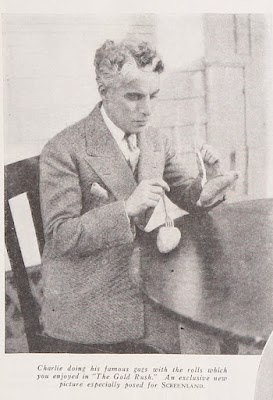 |
| Source: Screenland, December 1929. Unfortunately this version of the photo is reversed. |
Charlie's bio from Who's Who On The Screen (1920)

The photo used in the bio was taken at the White Studio in NYC, c. 1910-11, while Charlie was on tour with the Fred Karno Co. Photos from this sitting were used in ads, postcards, and other publicity materials through the early 1920s, even though more up-to-date photos of him were available.
.jpg)
November 14, 2012


Charlie & Russian opera singer Feodor Chaliapin, 1923

Subscribe to:
Posts (Atom)