Showing posts with label Rob Wagner. Show all posts

May 28, 2017

Chaplin at the volcano

Last month, David Totheroh, grandson of Chaplin's longtime cameraman Rollie Totheroh, visited the Kilauea volcano in Hawaii in hopes of locating the spot where Charlie and his companions took in the volcano in October 1917. He was kind enough to share with me (and you) his findings, as well as a "now" photo.

From David:
While geography changes in relatively drastic ways in volcano country, it is virtually incontrovertible that CC and entourage were pictured at the edge of Halemaumau, a small crater within the much larger Kilauea caldera. A Park Ranger suggested they were probably somewhere near the point that juts into the crater on the far side of the 'now' photo. But unless the 'then' photo was flipped (unlikely), it makes more sense to me, and fits better with the surrounding terrain, that they were in the area of that white patch on the edge of the rim on the closer side of the 'now' pic. In any case, the general public is no longer allowed any closer than the vantage point of my 'now' photo, so sitting at the same place where Charlie sat wasn't possible.
Then:


Now:

Photo courtesy of David Totheroh

Here's another interesting find.

At the time of Chaplin's visit, the Volcano House was the only hotel in the vicinity. The hotel's guest register is available for viewing on the National Park Service website. Below are the register entries for October 14th, 1917. I have included the Park Service's transcription of the text at the bottom. (There were some errors in their transcription which have been corrected, including "Ron" Wagner and Edna "Perrance").

Source: www.nps.gov/havo


"My stay at Hilo was very interesting. The landing stage, the pier, the city, and the hotel were very pleasant.
Tom Harrington, Los Angeles, 14 Oct 1917"

"When one writes his impressions in a public document such as this he is conscious that he is supposed to be original, witty or recondite and thus naturally edits what he really thinks. The most original impression I can record is that the crater in no way suggests hell to me. I cannot conceive of any such terrific beauty in hell. On the other hand the tropical jungle of the moss covered trees & huge ferns suggested the inferno of Dante--as conceived by Dore. Terrifying fire is the hell of fanatics, and was invented by them. Hell to a sensitive person would be the mockery and tragedy of tremendous contrasts. A beautiful woman without a soul is more infernal than an ugly old hag. Thus it is that the gray death that hangs over the tropical beauty of the jungle growth of the volcano--the ghastly quiet, the absence of all life in the midst of such a setting is most dreadfully suggestive of hell--whereas there is a splendor, a magnificent glory to the terrific cosmic forces within the crater that are pretty nearly the antithesis to my definition of hell. A description, like an attempted painting or a photograph, is a hopeless impertinence.
Rob Wagner, Los Angeles"

"You wish me to write my impressions of Hilo. Very good. Here it is. I saw the volcano.
Charlie Chaplin, Los Angeles"

"There are many charms in Hilo other than the Volcano. A maidenly diffidence forbids me suggesting the possessor of them."
Edna Purviance
Los Angeles"

September 2, 2016

Aloha, Kakou!

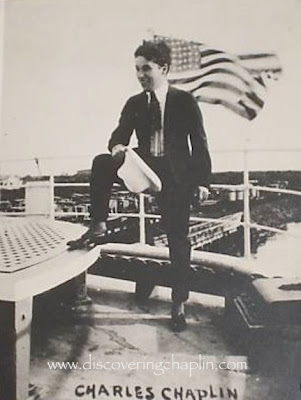
Chaplin visits the Kilauea volcano in Hawaii, October 1917

Chaplin aboard the Mauna Kea, Oct. 13th, 1917

The following article describes Chaplin's departure from Honolulu aboard the Mauna Kea bound for Hilo and the volcano.


Honolulu Star-Bulletin, October 15, 1917


Chaplin and Demosthenes "Monty" Lycurgus, the owner of the Volcano House Hotel.

Honolulu Star-Bulletin, October 27, 1917

More photos at the volcano. With Chaplin are Edna Purviance (seated), Rob Wagner (in white), and Tom Harrington (in dark jacket behind Edna).


February 25, 2016

Rare images from the set of SUNNYSIDE (1919)

These photos show Chaplin with the "wood nymphs" and some of the cast and crew.
The nymphs were played by Olive Burton, Willie Mae Carson, Olive Ann Alcorn, and Helen Kohn.

Chaplin's friend, Rob Wagner, is at far left. Rollie Totheroh is behind the camera.
In bowler hat is Tom Wilson, who plays Charlie's boss in the film.

August 19, 2015

Rare photos of Chaplin with Rob Wagner & his family

Many thanks to Wagner's great-grandson, Rob Leicester Wagner, for sharing these wonderful photos with me & for giving me permission to post them here.


With Wagner's wife, Florence. Behind them is Tom Harrington,
Chaplin's secretary.
On the set of The Adventurer (1917). At far right is Syd Chaplin. Next to him is Rob Wagner.
In front of Charlie, in white, are Wagner's sons Leicester (left) and Thornton (they are not twins).
Please comment if any of you can ID the other people.
Another on The Adventurer set. Charlie with Wagner's sons (Leicester on the right). 

August 19, 2014

August 12, 2014

Random Snippet

New York Times, April 25th, 1929

According to a Dec. 1929 Screenland article by Rob Wagner, before Charlie began having his hair professionally dyed, he applied a "daily smearing of mascara" to cover up his gray but it became "too messy & irksome." I can well imagine.

May 17, 2014

En route to Hawaii, 1917


Accompanying Charlie on the voyage was his friend, Rob Wagner (far left in top photo, 2nd from left in bottom photo) & Edna Purviance, who is not pictured. The man wearing the bowtie is Goldwyn executive, Harold Bolster.

Photos from Picture Play, 1917

December 22, 2013

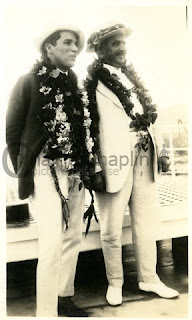
Honolulu, 1917

Charlie with Rob Wagner (left) and Edna Purviance
With Goldwyn Pictures executive, Harold Bolster

May 18, 2013

With his friend & political mentor, writer Rob Wagner

Wagner was the editor of Script Magazine, a New Yorker-style publication out of Los Angeles, which Charlie contributed to on a number of occasions.  He served as ghostwriter for Chaplin as well as press representative. He also made a brief appearance in the dance hall sequence of A Dog's Life (1918). It was most likely through Wagner that Charlie met two other intellectuals who helped shape his political viewpoint: Upton Sinclair and Max Eastman.