November 27, 2014

Happy Thanksgiving!

To celebrate the holiday, here are a couple of throwback posts about gastronomical Charlie.

Enjoy the day, American fans. Don't eat too much!


November 25, 2014

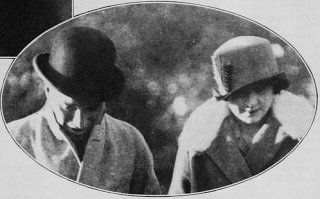
90 years ago today: Chaplin marries Lita Grey in Mexico

The couple at a train station in Shorb, CA the day after their wedding.

The ceremony was performed at 5:00 in the morning in Empalme, Mexico1 by a justice of the peace who spoke through an interpreter. Those in attendance were Chaplin’s valet, Toraichi Kono, his lawyer, Nathan Burkan, members of Lita’s family, Charlie's publicist Eddie Manson, and his friend, Chuck Reisner. Sixteen-year-old Lita, who was three months pregnant and suffering from morning sickness, was flanked by her mother. Chuck Riesner stood next to the groom, who held a lit cigarette between his fingers and puffed on it nervously throughout the ceremony. "Words cannot describe how grim [it] actually was," recalled Lita. When it was over, Charlie awkwardly kissed his bride on the cheek. She was then congratulated by her mother and Chuck, who had tears in his eyes. Lita looked around for Charlie but he had already left.

Afterward the wedding party gathered for breakfast, but Charlie was not in attendance. He had gone fishing. Lita remembered that "it felt as if we had gathered for a wake instead of a wedding." She did not see him again until that evening in the drawing room of the train headed back to Los Angeles. At one point, she overheard him tell his entourage, "Well, boys, this is better than the penitentiary but it won't last long."


When Lita finally entered their compartment, Charlie yelled loudly enough that others on the train heard him, "What are you coming in here for? You made me marry you." 3

In her book, Wife Of The Life Of The Party, Lita described what happened next:
In our stateroom, Charlie said to me, "Don't expect me to be a husband to you, for I won't be. I'll do certain things for appearances' sake. Beyond that, nothing."
My throat was dry and I felt nauseated. "Please, would you get me a drink of water?"
"Get it yourself. You might later claim I tried to poison you." I staggered to my feet to get the water. 
After watching me for several minutes, Charlie said, "Come on, I'll take you outside. The air will do you good." Standing on the platform of the observation car, I stared at the couplings of the train below, breathing deeply the cold night air. Charlie broke his aggressive silence and said to me, "We could put an end to this misery if you'd just jump."4
At a deserted station in Shorb, CA, Charlie and Lita disembarked from the train and dodged the press as they moved quickly to an awaiting limousine. One exchange went like this:

"Charlie, how about the wedding?" asked a reporter.
Charlie replied: "I don't want any publicity."
"Are you going back to Hollywood?"
"I don't want any publicity."
"The public is yearning to know about your romance."
 Charlie snapped back: "The public knows all about everything already. My life's an open book." 5 & 6

The reporters followed Chaplin's car twenty miles to his Beverly Hills house. They were stopped only by his security gate. Once Charlie and Lita were inside, he issued the following statement:

"Just tell everybody we are happy, thankful, and glad to be home."

Charlie and Lita in Shorb.
_________________________________________________________________________________


1 Charlie attempted to marry Lita in Mexico on October 14th, but when they filed the application, they were told that by Mexican law they had to wait 30 days before the marriage could take place. 

2 Lita falsely gave her age as 19 on her marriage certificate.

3 Lita Grey Chaplin's divorce complaint, reprinted in Wife Of The Life of The Party.  Lita also states in her complaint that she and Charlie became engaged in May 1924 and that Chaplin "seduced" her under the promise of marriage and that is how she became pregnant. 

Lita once told the "jump from the train" story in an interview and she said that she couldn't tell if Charlie was being serious or not.

5 Chicago Daily Tribune, November 28th, 1924

6 I've never understood why Charlie schlepped Lita all the way to Mexico to marry her when he could have had the ceremony in the privacy of his home and avoided all the publicity and headaches. Lita herself wondered the same thing and said his behaviour reminded her of someone who was "deranged."

November 24, 2014

Don't miss A DOG'S LIFE tonight on TCM (USA)--in prime-time (8pm EST)!

Chaplin's 1918 classic kicks off TCM's last night of their month-long salute to Silent Stars. The new French documentary The Birth Of The Tramp will follow at 8:45. The rest of the evening will include films by Buster Keaton, Harold Lloyd, and others. I'm so glad I can watch TCM again after being without it for a month due to the Time Warner/Dish Network dispute. This is my go-to channel and I was lost without it.

Film Fun, July 1918

November 22, 2014

Charlie at Jack Pickford's wedding at Pickfair, 1922

Charlie is in the center. Jack Pickford and his new wife, Marilyn Miller, are in front of him walking down the steps.
Douglas Fairbanks is inside the door (hard to see) and Mary Pickford is right outside the door wearing a white hat with her
head turned away from the camera.

See footage of the wedding here.

Charlie's JFK Connection

In the early stages of the screenplay for A Countess From Hong Kong, the character of Ogden Mears, played by Marlon Brando, was loosely based on President John F. Kennedy (in the original story, Mears was planning to run for president.) After Kennedy was assassinated, however, Chaplin revised the story because he didn’t want to offend the Kennedy family, especially Mrs. Kennedy.

Charlie with Marlon Brando on the set of A Countess From Hong Kong

Several years after Countess was released, producer and Chaplin family friend, Jerry Epstein, met Pierre Salinger, Kennedy’s press secretary. Epstein recalled their conversation in his book, Remembering Charlie:
"He said that Kennedy had planned to do something about Chaplin’s exile. Salinger was supposed to visit him and invite him back to the United States. But of course in the meantime Kennedy had been killed. Salinger also mentioned that he’d seen A Countess From Hong Kong. ‘I know who that picture was based on’ he told me. ‘Mr. Chaplin captured it very accurately.' So I guess we didn’t disguise the Kennedy aspect too well."

November 19, 2014

November 18, 2014

Lita Grey Chaplin in Honolulu, 1926

In November 1926, Lita spent three weeks in Hawaii with her mother and Charlie, Jr. A few days after their return, she separated from Chaplin and moved out of his house. According to Lita, Chaplin suggested that she take the trip to think things over. However in cross complaint for divorce, Chaplin states that he sent Lita to Hawaii to get her away from the car salesman with whom he believed she was having an affair. The cross complaint also states that while she was on the boat to and from Honolulu "she so conducted herself and engaged in such a course of conduct as to cause passengers on the boat both to notice and to comment upon her conduct and to make uncomplimentary remarks of and concerning her and her said conduct." Lita's behavior caused Chaplin, according to his cross-complaint, "extreme mental anguish and sorrow and great humiliation."1 He also accused her of spending hours away from Charlie, Jr. during the course of the trip. These allegations were nothing more than an attempt, and an unsuccessful one at that, by Chaplin's lawyers to paint Lita as an unfit mother.

See photos of Charlie posing with Lita and Charlie, Jr. prior to their departure for Honolulu here and here.


1Chaplin divorce documents reprinted in Wife Of The Life Of The Party by Lita Grey Chaplin & Jeffrey Vance, 1998

November 15, 2014

Random Excerpt

Journalist Sara Hamilton describes a day on the Chaplin lot during the filming of Modern Times:
A Chaplin picture conference is something that defies description. When the picture situations (they are never referred to as gags on the Chaplin lot) have been perfected in the mind of Chaplin--a long slow process that requires from two to four years--Della [Steele] and Henry [Bergman] are then summoned to a conference in Charlie's bungalow.
About the table they gather--and the situations are acted out one after the other. Charlie begins by taking his own role as the little tramp, closely watching their reactions to his every move. Henry, who weighs the better part of a ton, is then called upon to play Chaplin's role; Della takes Miss [Paulette] Goddard's role of the little street waif; Charlie is the factory foreman. Then swiftly they change parts again. Della is Charlie, the tramp; Henry is a policeman and Chaplin becomes the street waif. 
Henry Bergman and Della Steele, c.1935. ©Roy Export S.A.S.
It was his untiring striving for perfection in performance and his gentle patience with the clumsiest performer that impressed a titled visitor (and visitors are rare) at the Chaplin lot recently.  Rehearsals began at ten that morning with extras and bit players ready and waiting. Then began one of the strangest phenomena every witnessed. Chaplin directing his own picture. In explaining the action to the owner of the delicatessen shop, Charlie became the character. In some manner he took on enormous proportions, his face rounded, his hands grew massive and clumsy as the tramp faded in the background. 
In a flash he became the policeman, growing in stature before the eyes as he strutted, stormed and threatened. Then on to Miss Goddard's role. Prone on the sidewalk he wept, cried out in childish despair, "I didn't, please, please, I didn't steal the ham. Oh please, I didn't, Mister. Honest, I didn't." The voice, not Chaplin's, but the voice of the frightened waif--wept and cried and pleaded from the sidewalk. Now, in a flash, he was an extra tramp, weaving his gentle way in perfect rhythm in and out among the characters.  
Directing Paulette Goddard. ©Roy Export S.A.S.
From ten till four it went on without a moment's pause. And then, with the perspiration dripping down his face, he humbly thanked them all and with an apology for having carried them past the lunch hour, staggered off, tired and weary, to his little bungalow, his cane flipping a feeble staccato as he went. 
There is little boisterousness around the Chaplin studio. The Chaplinites feel that unwarranted noise or crude language might offend "him." "Him" in case you haven't guessed, is the little tramp, the tattered ragamuffin, the gallant little gentleman with his absurdly defiant elegance who picks his teeth with such delightful savoir faire and belches with such charming daintiness. 
To them this pathetic little creature who once, long ago, sprang from the forehead of Charles Spencer Chaplin, is a definite personality. He lives, he breathes, he thinks, he walks his troubled way alone. His name to all of them, is just "he."
In the midst of some hilarious bit of tragedy in which "he" finds himself involved on the set, Chaplin will figuratively stand aside and contemplate his little friend with an amused chuckle and a knowing wink that seems to say, "our little friend got himself into a fine pickle that time, didn't he?"
So it was when they showed Charlie the sweater knit by the loving hands of some dear old lady and sent over to the Chaplin studio with a note explaining it was for the little tramp when the wind blew cold. Chaplin's eyes grew misty as he said, "Write and thank her and tell her not to worry. "I'll always take care of 'him.'"
--Sara Hamilton, "The New Charlie Chaplin," Baltimore Sun, September 1, 1935 

November 14, 2014

Interview clips

Here is a compilation I put together of rare interview excerpts, probably from c. 1979, featuring Jackie Coogan, Lita Grey Chaplin, and Sydney Chaplin. These clips were extracted from the documentary Great Romances Of the 20th Century: Charlie & Oona Chaplin (1998).*

Note: Eric James tells a different version of Sydney's bathroom story here (or maybe it happened twice!)


*Many thanks to my dear friend, Lucy.

November 11, 2014

The eldest Chaplin boys during army induction and training


Charlie, Jr. at his army induction, 1943, (left) and during training at Camp Haan, CA, 1944
Sydney at his induction (left) and at the Ordnance Training Center in Flora, MS, 1944

View the enlistment records for Charlie, Jr. & Sydney here & here.

Both boys served in General Patton’s Third Army during WWII. Charlie, Jr. received two battle stars for his service.

He later remembered that his father was proud that he was in uniform.
He always lectured me about taking my duties seriously. I never left for camp that he didn’t put his arm around me and give me a pep talk.
"Charlie," he would say, "I want you to be a good soldier. If you don’t do anything else be a good soldier." 
And once he even received a rare, personal letter from him.
He must have just seen a newsreel of soldiers working their way through mined houses, because the letter was full of warnings about booby traps. He was genuinely worried. 
"Be careful where you walk, son," he wrote. "You might step on a mine and blow off your foot. It's not good to go through life maimed. Don't pick up strange objects, you might get a hand blown off."
He seemed especially concerned about pianos and singled them out for attention, warning me not to play on a strange one or to lift it or move it for fear the whole thing would blow up in my face. I suppose pianos troubled him so much because ever since I had shown an interest in music he had associated me with them. I had to laugh. Pianos were the least of my concern while bullets were flying overhead and shells were lobbing over and an occasional German plane was strafing us. (My Father, Charlie Chaplin, 1960)

November 10, 2014

Chaplin, Mabel Normand, and Roscoe Arbuckle, c.1914


Happy birthday, Mabel (November 10, 1893)*


Chaplin on Mabel:
The ‘he-man’ atmosphere of the studio would have been almost intolerable but for the pulchritudinous influence. Mabel Normand’s presence, of course, graced the studio with glamour. She was extremely pretty, with large heavy-lidded eyes and full lips that curled delicately at the corners of her mouth, expressing humour and all sorts of indulgence. She was light-hearted and gay, a good fellow, kind and generous; and everyone adored her. (My Autobiography, 1964)

Mabel on Chaplin:
Comedy has the broadest appeal to children--including adults--especially comedy with
heart. That is why Charlie Chaplin may stay off the screen as long as he likes and yet always return to crowds. When you see Charlie you don't just laugh from the throat, you laugh from the heart. (Photoplay, July 1925)

*Mabel's birthday is incorrectly listed on Wikipedia as November 9th, 1892. According to Mabel Normand researcher Marilyn Slater, her birthday is actually November 10th, 1893

November 8, 2014

Happy 100th birthday, Norman Lloyd!

Costume test photos of Norman Lloyd as Bodalink in Limelight (1952)

Lloyd met Chaplin sometime in the l940s through Tim Durant. He became a regular visitor to Chaplin's home, mostly due to their mutual love of tennis.

One of my favorite Lloyd anecdotes involves the time he tried to steal Chaplin's cane out of a closet at the studio:

One night we went down to the studio and we went into the cottage that had his dressing room and I just couldn't resist it. I opened the closet and I saw one of the canes. And I thought, "Well, Norman, this is the time you're going to steal this cane." I reached in and began to life it out. I hadn't figured a way of getting it out of there when Charlie came up beside me and said, "Ah, yes," and gently took it from me and just put it back. I had the feeling I wasn't the first one who had tried that. As he put it back, I looked down and came upon one of his secrets. There were the oversized shoes, the most famous shoes in the world. But in the oversized shoes was another pair of shoes, which were the correct size for Charlie's feet, so that when he walked the most famous walk in the world, in the oversized shoes, he actually was in another pair of shoes which gave him control. (interview with Lloyd for Unknown Chaplin
In the early 1950s, Chaplin and Lloyd came close to making the first film version of They Shoot Horses Don't They? Chaplin revealed to Lloyd that he had been to dance marathons and they fascinated him. He knew about the book, written by Horace McCoy, and had ideas about it long before Lloyd had read it. Around 1950, they purchased the screen rights. The deal was that Chaplin would write and produce and Lloyd would direct. Chaplin wanted his son, Sydney, for the male lead. Marilyn Monroe, a newcomer at the time & friend of Charlie, Jr. and Sydney, was considered for the role of Gloria Beatty. Lloyd recalled that Chaplin's ideas for the film were "so moving, so Chaplinesque. The leading character took on the flavor of Chaplin." (Lloyd, Stages Of Life)  Sadly, the project fell through after Chaplin was barred from returning to the States in 1952.  A film was eventually made in 1969, directed by Sydney Pollack with Jane Fonda and Michael Sarrazin in the leading roles.


November 7, 2014

Charlie on a high-wheel bicycle, c. 1919


See Charlie and Sydney try, unsuccessfully, to ride it here.

His Musical Career hits a snag


Filming this scene held up traffic for hours on a busy L.A. street.

Filming on location was the norm in the early silent days. But given its distractions, Charlie was often at odds with these expeditions. In fact, he loathed them.Therefore it's not surprising to find the following clipping about a problem Charlie encountered during location shooting for His Musical Career, which was released 100 years ago today.

Moving Picture World, October 24th, 1914. ("The Song Shop" = "His Musical Career")

According to Chaplin by Denis Gifford: "only Charlie's fame saved him from arrest."

For a closer look at the filming locations for His Musical Career see this post on John Bengston's "Silent Locations" blog.


____________________________________________________________________________________________________

1Chaplin, My Autobiography,: "I loathe working outside on location because of its distraction. One's concentration and inspiration blow away with the wind." Charlie was describing the location shoot for Shoulder Arms which was filmed during a "sizzling heat wave" and added that "working inside a camouflaged tree was anything but comfortable."

November 6, 2014

With violinist Jascha Heifetz on the set of THE KID, 1920


Dagmar Godowsky (daughter of Leopold) is second from left next to Heifetz in bow tie. Syd Chaplin is at far right.1


Around this time, Heifetz was a guest at Chaplin's house. "Everyone was clamorous to have Heifetz play violin. He picked up Chaplin's violin and started to play and he was astounded, as were the rest of the company, to find nothing but insane discordance issue from the strings.
Chaplin smiled, took his fiddle from Heifetz's hands and played a bit of Bach with his left hand. All the strings were on backward.
'You see,' said Chaplin, 'I am being made inside out and upside-down. When I turn my back on you in the screen you are looking at something as expressive as a face. I am back foremost.'"2


________________________________________________________


1Shortly after this visit, Heifetz, accompanied by Godowsky, flew to San Diego for a recital on an airplane from Syd Chaplin's airfield. The pilot was Syd's business partner, Emery Rogers. It was Heifetz's first flight. See photo here.

2Ben De Casseres, "The Hamlet-Like Nature Of Charlie Chaplin," New York Times Book Review, Dec. 12th, 1920.

November 5, 2014

Dish Network president threatens to blackout TCM and Turner Networks "forever"

(This might be of interest to others like me who have been without TCM the last two weeks due to the dispute between Dish Network and Time Warner).

Will McKinley sums up some recent comments by Dish Network chairman and soulless cretin, Charlie Ergen, who says that the blackout of TCM and other Turner networks is a "non-event":

http://willmckinley.wordpress.com/2014/11/04/dish-threatens-to-blackout-tcm-turner-networks-forever/


With Josephine and Victoria, French Riviera, c. 1956


Autographed photo with sketch, 1944

The photo shows Chaplin after he was acquitted of the Mann Act charge.


November 2, 2014

Twelve-year-old Lita Grey (then Lillita MacMurray) photographed as The Age Of Innocence, 1920

"After the [screen] test [for The Kid] was completed. Rollie [Totheroh] had some still photographs taken, as well as a special photograph Charlie had requested. Following Charlie's instructions, I was posed like the girl in Sir Joshua Reynolds' famous portrait The Age Of Innocence, for I had reminded him of the little girl in the oil painting. He thought it would make a memorable photograph." --Lita Grey Chaplin, Wife Of The Life Of The Party, 1998

From Wife Of The Life Of The Party
 by Lita Grey Chaplin & Jeffrey Vance
The Age Of Innocence by Sir Joshua Reynolds (1788)

Family photo, c. 1952

L-R: Geraldine, Oona (holding Victoria), Josephine, CC, & Michael, who is mimicked by his father.
Photo by W. Eugene Smith for Life magazine ("Chaplin At Work," March 17, 1952)