 |
| Illustrated, October 4th, 1952 |
Showing posts with label Mutual. Show all posts
Showing posts with label Mutual. Show all posts
November 16, 2016
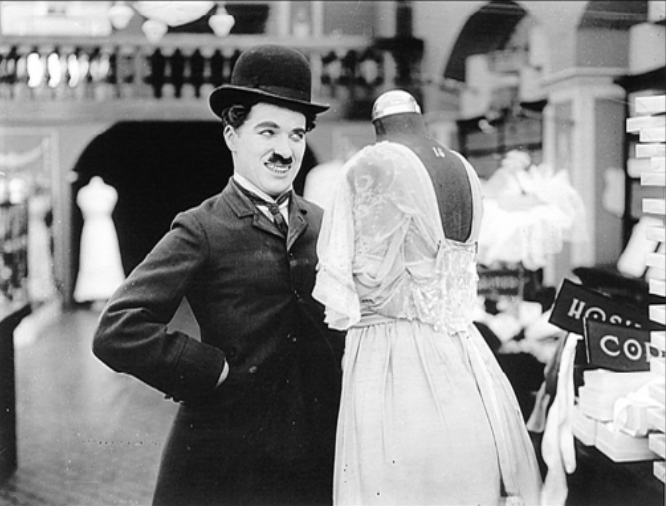
On a film set, 1916
I believe this was taken during the filming of The Count. The dining room set can be seen in the background through the arched doorway. However, the set that Chaplin is standing in does not appear in the film, perhaps it was an early version of the ballroom set. The sofa on the left was also used in Behind The Screen.
September 4, 2016
THE COUNT, released 100 years ago today

The Count was a struggle for Chaplin from the beginning. He built a set, as he often did, "with not an idea in my head."1 This lack of inspiration caused him a great deal of anxiety: "When I arrive in the morning I'm usually gloomy, especially when I haven't any idea what I'm going to do in a scene...," he told journalist Grace Kingsley in August 1916, "tears bedew my eyes as I put on my makeup, and I weep sadly as I step out on the stage."2
His first plea for help went out to his brother, Sydney, who was in New York at the time. How much Charlie counted on him for brainstorming gags and scenario possibilities is evident in their correspondence when Syd was away.
Wiring him at the Hotel Bonta in New York City, July 31, while he would have been filming The Count, Charlie pleaded: "Have you any suggestions for scenes? Have dining room and ballroom. I am playing a count but an imposter to win an heiress but cannot get story straight. Wire me some gags if possible. Playing in Chaplin make-up in fancy dress ball." Charlie's problems with this story continued, however, causing him to film the mostly one-man-show One A.M. in the meantime. By August, the situation was so dire that Charlie's butler and Man Friday, Tom Harrington, wired Sydney again:
"Charlie is very depressed condition for past two weeks. Doesn't seem able to get mind around to his story. He wishes nearly every other day that you were here...Think it very important for his future success for you to drop everything in New York and come here immediately at least three or four weeks. Charlie hasn't been sick but whenever he gets into difficult situation, which doesn't work out satisfactorily, he always wishes Syd were here."
Five days later Charlie wired his brother himself: "The last two pictures have given me great worry and I need you here to help me. Drop everything and arrange to be in Los Angeles by August 12 to help me in directing next picture. Wire answer immediately."3Why was Sydney tormenting his brother this way? It seems Sydney felt "used" by Mutual and that they weren't paying him what he thought he was worth. A settlement seems to have been reached because Sydney eventually returned to California.4
The Count's ballroom scene appears to have caused Chaplin the most stress. He told Grace Kingsley:
"And as for these gray hairs"--indicating those about his temple over his right ear--"I got them all the other day trying to be funny in a ballroom scene. I think any comedian who started out to be funny in a ballroom would have his career blighted at the outset." 5
 |
| Illustration by Gale for Grace Kingsley article, Los Angeles Sunday Times, Aug. 20th, 1916 |
Charlie wasn't the only one driven crazy by this scene. Chester Courtney, an old music hall acquaintance who had been given a job at the studio, recalled:
If anyone were to play "And They Call It Dixieland" in my hearing I should run, screaming! It nearly lost me my sanity, thanks to Charlie. He kept a studio band playing it for weeks learning to dance with Edna Purviance."6Despite all the problems, The Count was well-received among critics and fans, who had been disappointed with his last film One AM. The public felt that Chaplin had made a come back of sorts.
The inimitable comedian returns to the type of motion picture farce in which he gained his fame and is seen in his familiar baggy trousers, cutaway coat at least two sizes too small, his dinky derby, diminutive moustache and slender cane, not forgetting the celebrated brogans.7

_________________________________________________________________________________
1 Charles Chaplin, My Autobiography, The Bodley Head, 1964
2Grace Kingsley, "Beneath The Mask: Witty, Wistful, Serious Is The Real Charlie Chaplin," Los Angeles Sunday Times, August 20th, 1916
3 Lisa K. Stein, Syd Chaplin: A Biography, McFarland, 2011
4ibid
5 Grace Kingsley, "Beneath The Mask: Witty, Wistful, Serious Is The Real Charlie Chaplin," Los Angeles Sunday Times, August 20th, 1916
6Chester Courtney, "The Real Charles Chaplin," Film Weekly, Feb. 1931
7Moving Picture World, September 2nd, 1916
July 26, 2016
Between takes on the set of THE ADVENTURER, 1917

Other familiar faces include Albert Austin (far right) and Rollie Totheroh (behind the camera). The man on the left looks like someone I should know as well. Fred Goodwins?
July 10, 2016
THE VAGABOND
Chaplin's third Mutual film was released 100 years ago today.
Chester Courtney, a fellow comedian with the Fred Karno troupe, who was employed by Chaplin at the time, recalled watching the final scene (above) being filmed: "Both Chaplin & Edna were in tears, and, as he took his last farewell, lifted his narrow, pathetic shoulders in a wistful gesture of resignation and sloped away towards the evening light, there was not a tearless eye among the 20 persons who watched spellbound."
The story goes that Chaplin filmed an alternate ending to The Vagabond in which Charlie attempts suicide by throwing himself into the river. He is rescued by a homely maiden (played by Phyllis Allen) but plunges back into the water after one look at her face. It is up for debate whether or not this footage exists, or ever existed. However, two contemporary trade magazines described this second ending: A pre-release blurb in the June 24, 1916 issue of Reel Life (a Mutual publicity magazine) and in an apparent review in the July 29, 1916 issue of the New York Clipper. Both describe Chaplin's suicide attempt being thwarted by a "buxom country maiden" (Phyllis Allen) who had befriended him.* Reel Life goes further and describes Allen's character as a farm woman whom Charlie has been flirting with in order to get such things as free eggs. That's why, when he attempts suicide, she jumps in to rescue him. There is a brief scene in the final film where Charlie gets some eggs from a farm woman but we don't see her face. Here is a screenshot:

Below is a real shot of Phyllis from behind (from The Rounders).

I don't think the farm woman is Phyllis because her hair is lighter and she just seems smaller to me. But I could be wrong. Nevertheless, Phyllis does appear in the movie at the end (at least I think it's her). She is the other woman (below, second from left) who arrives in the car with Charlotte Mineau. I haven't watched the Mutuals in a while but I don't recall seeing Phyllis in any of the other films so it's interesting that Chaplin cast her in this one.

Sources:
The Chaplin Archive, ed. by Paul Duncan
Chaplin's Vintage Year by Michael Hayde
Chaplin: His Life & Art by David Robinson
www.nitrateville.com
 |
| A classic Chaplin entrance showing only his familiar feet. |
 |
| We get to see a lot of Chaplin's left-handed fiddle playing in this film. |
 |
| Edna, the Gypsy Drudge |
 |
| His crazed violin playing for Edna causes him to fall into the tub. A precursor to the final scene in Limelight. |
 |
| An artist, played by Lloyd Bacon, takes an interest in Edna. Bacon went on to become a successful director. Among his credits are the Busby Berkeley musicals 42nd Street and Footlight Parade. |
 |
| "Goodby, little girl" or is it? |
Chester Courtney, a fellow comedian with the Fred Karno troupe, who was employed by Chaplin at the time, recalled watching the final scene (above) being filmed: "Both Chaplin & Edna were in tears, and, as he took his last farewell, lifted his narrow, pathetic shoulders in a wistful gesture of resignation and sloped away towards the evening light, there was not a tearless eye among the 20 persons who watched spellbound."
The story goes that Chaplin filmed an alternate ending to The Vagabond in which Charlie attempts suicide by throwing himself into the river. He is rescued by a homely maiden (played by Phyllis Allen) but plunges back into the water after one look at her face. It is up for debate whether or not this footage exists, or ever existed. However, two contemporary trade magazines described this second ending: A pre-release blurb in the June 24, 1916 issue of Reel Life (a Mutual publicity magazine) and in an apparent review in the July 29, 1916 issue of the New York Clipper. Both describe Chaplin's suicide attempt being thwarted by a "buxom country maiden" (Phyllis Allen) who had befriended him.* Reel Life goes further and describes Allen's character as a farm woman whom Charlie has been flirting with in order to get such things as free eggs. That's why, when he attempts suicide, she jumps in to rescue him. There is a brief scene in the final film where Charlie gets some eggs from a farm woman but we don't see her face. Here is a screenshot:

Below is a real shot of Phyllis from behind (from The Rounders).
I don't think the farm woman is Phyllis because her hair is lighter and she just seems smaller to me. But I could be wrong. Nevertheless, Phyllis does appear in the movie at the end (at least I think it's her). She is the other woman (below, second from left) who arrives in the car with Charlotte Mineau. I haven't watched the Mutuals in a while but I don't recall seeing Phyllis in any of the other films so it's interesting that Chaplin cast her in this one.

Sources:
The Chaplin Archive, ed. by Paul Duncan
Chaplin's Vintage Year by Michael Hayde
Chaplin: His Life & Art by David Robinson
www.nitrateville.com
December 4, 2015
THE RINK, released December 4th, 1916
The Rink was Chaplin's 8th film for Mutual & the first to display his rollerskating prowess, skills he had doubtlessly developed in the c.1909 Fred Karno sketch, Skating, which was co-written by Syd Chaplin (both brothers performed the sketch for different Karno touring companies). He employed another skating routine twenty years later in Modern Times, which revives some of the restaurant gags in The Rink as well.
Not surprisingly, others in the cast, who may not have been as comfortable on skates as Chaplin, were black and blue during rehearsals:

A few favorite scenes:


Not surprisingly, others in the cast, who may not have been as comfortable on skates as Chaplin, were black and blue during rehearsals:
Charles Spencer Chaplin and Mutual players have begun the filming of a rollerskating rink story. The script provides that each one of the troop shall become proficient in the art of retaining their equilibrium, and the stage at the studio has been the scene of many tumbles that will not appear on the screen. Eric Campbell, the six-foot-two heavyweight, is reported to have ruined one section of the flooring, and other members are nursing bruises which in some instances require meals served from the mantelpiece. General Manager H. P. Caulfield is putting in all his time preventing the artists from completely destroying the plant. (Motion Picture News, December 9th, 1916)To give an idea of The Rink's popularity with audiences, here is a clipping from a 1917 issue of Motography. It's hard to tell if the owner of the theater was being serious:

A few favorite scenes:


 |
| This was Henry Bergman's first appearance in drag in a Chaplin film. |


June 12, 2014
THE FIREMAN, released June 12, 1916
"I was passing a firehouse one day, for example, and heard a fire alarm ring in. I watched the men sliding down the pole, climbing onto the engine, and rushing off to the fire. At once a train of comic possibilities occurred to me. I saw myself sleeping in bed, oblivious to the clanging of the fire bell. This point would have a universal appeal, because everyone likes to sleep. I saw myself sliding down the pole, playing tricks with the fire horses, rescuing the heroine, falling off the fire engine as it turned a corner, and many other points along the same lines. I stored these points away in my mind and some time later, when I made The Fireman, I used every one of them. Yet if I had not watched the firehouse that day the possibilities in the character of a fireman might never have occurred to me." (Charles Chaplin, "What People Laugh At," American, November 1918)Certain scenes in The Fireman were filmed at an actual Los Angeles fire house. The two burning houses shown in the film were studio-created facades, not real condemned houses which Mutual claimed in its publicity at the time. However it's remarkable to watch Chaplin climb the three-story set in one take.


May 15, 2014

April 16, 2014

February 24, 2014
Charlie and Edna with visitors on the set of THE CURE, 1917
Charlie is in costume as a bellhop, the character he had originally intended to play before switching to the drunk.


 |
| Eric Campbell is standing behind the fellow shaking Charlie's hand. |
October 22, 2013
THE ADVENTURER, released October 22nd, 1917
This was Chaplin's last film for Mutual, it also marked the last film for Eric Campbell who was tragically killed in a car accident in December 1917.
I went a little crazy with screenshots on this one.


I went a little crazy with screenshots on this one.
 |
| Charlie is Convict #23 (aka "The Eel"). He will play another escaped convict (again #23) in his last film for First National, The Pilgrim (1923). |

 |
| Eric Campbell with Edna Purviance. |

 |
| On the left is Chaplin's long-time secretary and "Man Friday," Toraichi Kono. Kono also had a bit part as a chauffeur in A Day's Pleasure. Rumor has it he is a face in the crowd in The Circus.  |
 |
| In order not to be recognized at the party, Charlie draws a mustache on his picture in the newspaper to make himself look more like Eric Campbell. |
 |
| This won't end well. |
 |
| Charlie realizes the ice cream has gone down his pants. I'll end it here. |
October 2, 2013

September 17, 2013

September 6, 2013
August 7, 2013

June 23, 2013


May 21, 2013


May 15, 2013
May 4, 2013
Outtake from THE COUNT (1916)

In the final film, Eric Campbell is seated in John Rand’s place, so Charlie doesn’t have to lean across Edna Purviance:

Subscribe to:
Posts (Atom)