March 31, 2013

World Tour (1931-32) Revisited: Nice, March 31st, 1931


Charlie at the train station in Nice.

Except from A Comedian Sees The World:
My next move was to the south of France to visit my brother who had been living there for the last six months. I was to be the guest of Frank J. Gould in Nice, so after nine days in Paris, I arrived in the south of France, the playground of the fashionable world. 
Nice is a night's journey from Paris, and you arrive on the Cote d'Azur, "the blue coast," about noon, getting your first glimpse of the Mediterranean. It is a pity the railroads are so near the sea. They spoil the coastline. I am a little disappointed with my first glimpse of the country. It seems so congested with its houses on top of one another, so different from the open spaces of the coastline of California.
My friend Frank Gould and his wife met me at the station, along with my brother Syd and his family. I shall not go into the details of the welcome I received from the crowd. Nevertheless Frank Gould was considerably moved by the demonstration.
"It must make you very happy to be so admired," he remarked.
But after lunch he went with me to buy some tennis rackets, and as we walked along crowds started gathering until we stopped the traffic. People were pushing and shouting, "Hooray, Charlie!" They became so dense and demonstrative that we could hardly move on our way.
I could see Frank getting quite worried and when we eventually arrived home he declared, "I wouldn't be you for ten million dollars."

A gathering at the Majestic Hotel in Nice. Chaplin's host, Frank J. Gould, is on his right.
Gould, who was once married to Hetty Kelly's sister,  owned the hotel
 and provided Charlie and his entourage with a suite.
His wife, Florence, is on Charlie's left. Syd is seated next to her. 
Syd and Charlie in Nice.

Charlie Chaplin, Jr. describes an Easter from his childhood

Up until this year, Syd and I had not participated in the coloring of the eggs. But that Easter Eve we were allowed to help Paulette, all three of us working away in the living room. Dad reserved himself the hiding of the eggs, a chore he loved because of its conspiratorial nature. I have never ceased to be amazed at the simplicity of the things in which my father found so much pleasure. I can remember him with that sly expression on his face, packing us off to bed so he would have freedom to work. He hid the eggs in the chairs and the sofa of the living room, in the dining room, out on the lawn.

Easter morning we had a late breakfast together on the porch, and the relaxed atmosphere was like a burst of sunshine after Dad’s tension of the last months. A little later Syd’s and my friends gathered for the hunt. Soon there were children all over the place, squealing and yelling and tearing everything apart in their exuberant search. And there was Dad following right behind us with his hands clasped behind his back, as though to keep from rooting out the eggs himself.

“Now you’re hot! Now you’re cold! Lukewarm now!” his steady monologue guided us like manikins on a string until we found them all. (My Father, Charlie Chaplin, 1960)

March 30, 2013

World Tour (1931-32) Revisited: Charlie leaves Paris for Nice, March 30th, 1931

Charlie on the Riviera, 1931 (Lisa Stein Haven)

Charlie's visit to the French Riviera will prove to be a turning point. Not only will he see his half-brother, Sydney, but more significantly, he will meet an Austrian dancer named May Reeves, who will become his lover and traveling companion for the next year. More on that to come...

World tour scorecard (so far):

Duration: almost 7 weeks

# of cities visited: 5

Girlfriends: 5-6 (at least one at every "port")

Charlie's left-handed Rolex watch will be up for auction in NYC on April 10th

www.antiquorum.com

Click here for more info. The auction estimate is $8,000-$12,000.

March 28, 2013

Charlie (left) at the wedding of Mary Pickford & Douglas Fairbanks, March 28th, 1920


In his autobiography, Charlie claimed he was not invited to the ceremony because he had spoken so strongly against their marrying (he told them they should “just live together and get it out of their systems”) that when Doug & Mary finally did so, they invited all of their friends but him. Not so, apparently.

World Tour (1931-32) Revisited: Photos by Lee Miller, Paris, 1931

Model-turned-photographer Miller first met Charlie in New York in 1927 and the two evidently became lovers.

Arguably the most famous image from this 1931 session is the shot of Charlie posing beneath a large Art Nouveau chandelier. Both of them enjoyed the session. Thinking about it years later, Miller laughed: “Charlie told me that he had never had such a good time in his life as he had with what he called my surrĂ©aliste photography."*

I have only ever seen three photos from this session but evidently a fourth photo was published in the French magazine Pour Vous in April 1932 (the bottom photo is on the cover). I have not yet been able to get my hands on a copy of this magazine.*

Charlie participated in at least three professional photo sessions while he was in Paris during his world tour. I will post photos from one more tomorrow. Since he returned to Paris at least once later in the year, it's unlikely all of them were done during his week-long visit in March but it is difficult to find the exact dates of the sessions.

*Update: here are the other photos.


*Lee Miller: A Life by Carolyn Burke

March 25, 2013

World Tour (1931-32) Revisited: Boar hunt in Normandy, March 25th, 1931


Shortly after Charlie arrived in Paris, he took a side trip to Normandy to go boar hunting with the Duke of Westminster. At the train station, a reporter asked him about the hunt: "I shall enjoy [it] but I shouldn't like to shoot anything. I am too soft-hearted."

This would be the first time Charlie had been on a horse in years and he was concerned about whether or not he could stay on the animal and what he would do if he were actually confronted with a boar.  These thoughts kept him awake the night before the hunt.


Adding to his worries was the fact that he didn't bring the proper clothing and had to borrow a jacket & gloves from the Duke, who was twice his size. "The duke's gloves were so large I found I could close my fist inside without disturbing the fingers," Charlie recalled.

The Duke was informed that boar tracks had been found so the hunting party drove forty miles to the location.  They had to wait another hour in the cold for the horses and dogs to arrive. The first horse that was presented to Charlie “reared up on her hind legs, cavorted and pranced around, then sidled towards me as though desiring to sweep me off the road. But I was too quick for her. I was behind one of the cars in a jiffy.” Charlie was then brought another, more well-behaved horse. 


Charlie hiding from the horse, illustration from "A Comedian Sees The World,"
A Woman's Home Companion, Nov. 1933
The hunt lasted for hours and no boar materialized. It also left Charlie in terrible shape physically. When he finally dismounted from the horse, his knees gave way completely and he struggled to stand up.

He returned to the Duke's chateau where his valet, Kono, was waiting for him. After dinner, they left for Paris where Charlie was eager to take a Turkish bath. "It was four in the morning before I emerged from the manipulations of a masseur," recalled Charlie. 

For days, he could not sit or stand without groaning and had to eat his meals standing up at the fireplace.  He decided then and there that he would confine his future participation in sports to "tiddledy winks."


Sources:
"A Comedian Sees The World, "A Woman's Home Companion, November 1933
Charlie Chaplin: King Of Tragedy by Gerith von Ulm
The Daily News, Perth, May 5th, 1931

This post is part of my series, World Tour Revisited, in which I follow Chaplin on his travels around the world in 1931-32.

March 22, 2013

World Tour (1931-32) Revisited: Paris, March 22nd, 1931

Charlie arrived in Paris from Venice to a near-riot situation. When he stepped onto the platform the crowd went wild, chanting, "Charlot! Charlot! He's a splendid fellow!" Many enthusiastic fans broke through the police barrier to kiss Charlie on the cheek.

Charlie is mobbed by fans in Paris.

He was met at the train station by Cami, the French humorist, whom Charlie met during his visit in 1921. However his appearance irritated him rather than pleased him, especially when Charlie suspected he was involved in a plot to get him to speak into a microphone that was thrust before him. In reality, he had only whispered to Charlie that it might please the crowd if he said, "Bonjour Paris." Cami accompanied the Chaplin party to the Crillon but Charlie, still angry, insisted that he be barred from attending a reception that was awaiting him in his hotel suite.

Charlie's main reason for visiting Paris was a meeting with foreign minister, Aristide Briand, and to receive the LĂ©gion d'honneur.  Of course, he will also visit Napoleon's tomb.


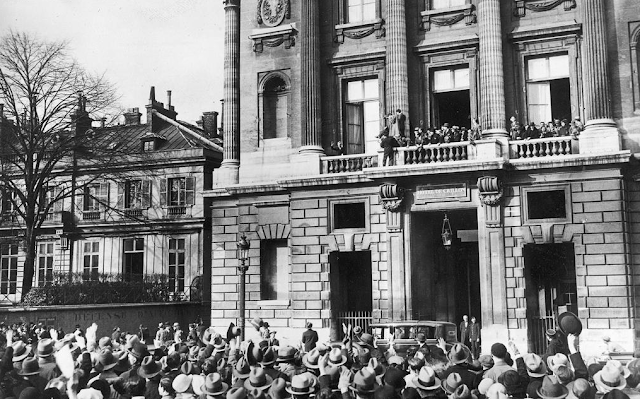
Above: Arriving at the Hotel Crillon.


 (Above and below) Charlie greets fans on the balcony of the Hotel Crillon, March 22nd, 1931.


At the hotel, Charlie met with a roomful of reporters, where he informed them that he would not remain in Paris for the premiere of City Lights: "I came to Europe for a vacation and a rest, but the wonderful receptions I have had everywhere have not given me much time for repose. So I intend to proceed to someplace on the Riviera where I can loaf a bit. Then I plan to visit Madrid before returning to the United States."

As we will see next week, Charlie's immediate plans to visit Spain and then return home will change once he gets to the Riviera.

Meeting the press. 

Sources: 
Chaplin: His Life & Art by David Robinson
Chicago Tribune & New York Times, March 23rd, 1931

March 19, 2013

Charlie & Paulette with Betty Hill (left), c. 1936

Hill was the wife of King Vidor.

World Tour (1931-32) Revisited: Venice, March 19th, 1931

Below is newsreel footage of Charlie's gondola ride through the Grand Canal in Venice on the day of his arrival. The crowds would applaud and shout "chow!" as his boat passed. "It is their greeting," he remembered, "and so I am 'chowing' from then on."


Next stop: Paris on March 22nd. The next leg of Charlie's trip is an interesting one. After a week in Paris (which will include a side trip to Normandy to go boar hunting), he will move on to Nice. There he will reunite with his brother, Sydney, as well as meet the woman who will remain with him for the next year. Stay tuned...

March 18, 2013

World Tour (1931-32) Revisited: Romantic adventures in "sad" Vienna

Charlie spent three short days in "sad, sensuous Vienna."*  His original plan was to stop over for a few hours in the city then move on to Budapest. But his plans quickly changed when he met a lovely pianist named Jenny Rothstein. "Within an hour of his meeting her he was enthusing about her future--on the concert platform in the United States. At the end of another hour he had lost all interest in Budapest. Didn't care if he never saw the place!"**

On his second evening, Chaplin attended a musical-comedy. He was struck by the performance of its star, Hungarian actress & dancer, Irene Palasty. During the intermission, he met her backstage. Later that evening, they tangoed at a cabaret, but the evening went downhill from there:

After the theater we went to a cabaret. I danced several tangos and was having a wonderful time until we struck one of those excitable wenches. This time there were fireworks.
She was a Hungarian. "Ach, here is a great artist," she announced, eulogizing me with all the superlatives she could think of.
I am not a man of false modesty, but I actually squirmed. She suddenly fell to her knees and with a panache gesture grabbed my hand and kissed it. In endeavoring to pull away she yanked me off my balance and I toppled over on her.
I might mention I was perfectly sober, not having had a drink that evening, but the manner in which the proprietor picked me up convinced me that he suspected that I had.
"Everything is all right, Mr. Chaplin. It is quite all right." Feeling an explanation necessary, I endeavored to tell him I was perfectly sober, but he insisted. "Don't mention it, Mr. Chaplin."
The affair was exasperating and I left with a resolve never to enter a cabaret again.
Backstage with Irene Palasty

Chaplin's press agent, Carlyle Robinson, offers a slightly different version of the evening in his article, "The Private Life Of Charlie Chaplin." According to him, Charlie was sitting at an inconspicuous table when Ms. Palasty arrived with her husband. He was hoping she wouldn't notice him, but...
Unhappily at the end of an anxious half hour she did. Shrieked the news to the entire room. Rushed across the dance floor and fairly flung herself upon the much embarrassed Chaplin. His struggles to extricate himself were futile. The crowd looked on and applauded.
Eventually he managed to get out of the place. As we hurried along to the hotel Charlie cursed Budapest up hill and down dale. It seemed that Irene hailed from that city. If all Budapest ladies were as demonstrative as Frau Palasty, he growled, it was no place for him.
Charlie left Vienna for Venice on March 18th. Only Jenny Rothstein saw him off at the railway station. Years later in in autobiography, Charlie's lasting memory of the city was a romance he had with a girl he met there.
It was like the last chapter of a Victorian novel: we made passionate vows of affection and kissed good-bye, knowing that we would never see each other again. 
He didn't mention the girl by name. Was it Jenny Rothstein?***


* My Autobiography
**"The Private Life of Charlie Chaplin," by Carlyle Robinson, Liberty, 1933. 
***For the life of me, I could not find a picture of Jenny Rothstein, or any information about her at all. David Robinson refers to her as "Jennie Rothenstein," so I tried a search under that name, but to no avail.  Perhaps her name was incorrectly remembered by Carlyle Robinson.

New paperback reissue of MY AUTOBIOGRAPHY is now available on Amazon (U.S.)


Click here for more info. The Nickolas Muray photo on the cover is one of my favorites (even though it is flipped in the wrong direction).

March 16, 2013

Convict #23 aka "The Eel" (The Adventurer, 1917)


World Tour (1931-32) Revisited: Vienna, March 16th, 1931

I arrived [in Vienna] to another big demonstration. Each crowd seems to get bigger and more demonstrative, God bless them! This time I am carried shoulder high out of the railroad station. It is impossible to retain one's personality in this fashion. One looks foolish and concerned.


As we progress I am thrown more out of balance, but am eventually dumped into a touring car, with my secretary and Kono being pushed in after me. And so we sally forth, waving and honking our way out of the crowds....
Upon arriving at the hotel I am ushered into a palatial apartment. It is the royal suite. The rooms are large and lofty, painted white and decorated in rococo style. It is extremely impressive but you get tired of it after a few days. ("A Comedian Sees The World," Oct. 1933)
Later that evening Charlie left the hotel to take a nocturnal stroll by himself, something he always enjoyed doing when he arrived in a new city. But he was immediately recognized and a throng of fans began to follow him. He quickly hopped into a taxicab and escaped to Prater, a popular amusement park, where he found refuge on a ferris wheel.

Happy birthday, Sydney (March 16th, 1885 - April 16th, 1965)


March 15, 2013

New York, 1927

Photo from German magazine Revue des Monats, 1927.

World Tour (1931-32) Revisited: Romance in Berlin


Although his visit to Berlin lasted only a week, it didn't take Charlie long to find himself entangled in the charms of the opposite sex.

The first woman to pique his interest was a Viennese dancer named La Jana, whom he refers to as "G" in "A Comedian Sees The World." Chaplin said he met her at a party given by playwright Karl Vollmoeller. However, according to Charlie Chaplin: King Of Tragedy, written by Gerith Von Ulm (with information supplied by Chaplin's servant, Toraichi Kono), they met when La Jana and a friend showed up at his hotel suite one afternoon unannounced. Nevertheless, he was instantly infatuated and La Jana began accompanying him to parties and nightclubs. On their last evening together, they dined and danced at a gathering hosted by Sir Philip Sassoon. The following is Charlie's description of their last conversation:
"G" is very lovely. When I first saw her dance I was struck by her extraordinary charm, the rhythmic motion of her body and her volatile expression. She knew I appreciated the nuances and subtleties of her dance.
That evening after Sir Philip left, "G" and I sat and talked. I attempted to define the quality of her art.
"In your dance you seem to express an exotic loneliness--to be in pursuit of some strange beauty. This quality is part of your real personality."
"G" took my hand. Hesitating to find words she replied, "Charlie, I love you--you're so appreciative. Although we may never see each other again, I will not regret it. For we have met in our pilgrimage. It is good to know that you are in life, and a living part of it."
That was "G"--that was her philosophy. 
Betty Amann
Theodore Huff suggests that once Charlie was informed that La Jana was "a favorite of the old Crown Prince," he switched his interest to actress Betty Amann. Not much else is known about their romance except that she was the only girl to accompany Charlie to the train station when he departed for Vienna on March 15th. He embraced her, gave her "four kisses," & called "goodbye, sweetheart" as the train rolled out. She later declared to a reporter that she liked him very much.

And thus Charlie's romantic adventures in Berlin came to an end.

Betty & Charlie say goodbye in Berlin.


Sources: 
A Comedian Sees The World, Nov. 1933
Chaplin In Berlin by Wolfgang Gersch 
Los Angeles Times, March 16th, 1931

March 14, 2013

World Tour (1931-32) Revisited: Out and about in Berlin, March 9th-15th, 1931

Charlie visits with children in the poor section of Berlin (above and below).


At  police headquarters in Berlin where Charlie visited the Police Museum.
“Frightening and depressing was my visit to the Berlin Police Museum--photographs of murder victims,
suicides, degenerates and human abnormalities of every kind”  (MA, pg. 360)

Tea with the Berlin chief of police, Albert Grzesinski, second from right.  

With German Minister of Interior Joseph Karl Wirth.

Tomorrow: Charlie's romantic adventures in Berlin.  Next stop: Vienna on March 16th.