January 30, 2013

"La Violetera"


Charlie was so taken with Spanish singer Raquel Meller's interpretation of Jose Padilla's "La Violetera" that he used the song in City Lights. I have a feeling he was probably a little taken with Raquel herself and like Charlie did with many of his female friends/companions, he offered her the role of Josephine in his never-to-be-made Napoleon movie.

Chaplin & Raquel Meller on the set of The Circus, 1926
Charlie met Raquel again in 1931 when City Lights premiered in the south of France. Meller performed the song as part of the opening program. May Reeves recalls the event: "During our stay at Juan-Les-Pins, City Lights premiered at Antibes. It was a great event for all the Côte d'Azur, heightened by the presence of Chaplin & Raquel Meller, who sang "La Violetera" with immense success. She admired Chaplin very much and asked him to write a scenario for her."

France, 1931. Charlie & Raquel are on the left. May Reeves is on the right. 

January 28, 2013

Premiere of THE CIRCUS Party for Marion Davies, 1928


The above photo is often incorrectly labeled as having been taken at the premiere of either The Circus or City Lights. However it was actually taken at a welcome home party that was given for Marion Davies at the Ambassador Hotel following her return from Europe in October 1928.

Below is a group photo from the same event. Original photograph caption dated October 31,1928 reads: "Photo shows a distinguished group of filmland notables at a welcome party honoring Marion Davies, famous star just returned from a three-month trip abroad. Standing, left to right, Lorraine Eddy, Matt Moore, Aileen Pringle, Louis B. Mayer, Gloria Swanson, Harry d'Arrast, Miss Davies, Louella O. Parsons, Ricardo Cortez, Charlie Chaplin, Norma Shearer, Irving G. Thalberg, Harold Lloyd and Robert Z. Leonard. Seated in foreground are Harry Crocker, left, and William Haines. The French room of the Ambassador was transformed into likeness of a Parisian cafe for the surprise party greeting Miss Davies." (Los Angeles Herald-Examiner Collection)


On tour with the Fred Karno Co., Butte, MO, c. 1912-13


In his autobiography, Charlie recalled that the prettiest prostitutes in the West were in Butte:
Butte boasted of having the prettiest women of any red-light district in the West, and it was true. If one saw a pretty girl smartly dressed, one could rest assured she was from the red-light quarter, doing her shopping. Off duty, they looked neither right nor left and were most respectable.

January 26, 2013

Photo by Apeda Studios, NYC, c. 1927


100 years ago today

Source: Linda Wada @ Edna Purviance--Chaplin's Leading Lady
"Sunday, January 26, 1913 - Fred Karno Company, with Charles Chaplin, were in San Francisco getting ready to perform a Sunday afternoon program at the Empress Theater. This was Chaplin's fourth trip to San Francisco and was one of his favorite cities.

Chaplin first came here in 1911 (not 1910, as he said in his Autobiography). Unlike London, San Francisco (like the other western cities) all looked new to him. Especially San Francisco, since they were just in the first few years of their recovery from the April 1906 earthquake and getting ready for the 1915 World Exhibition. 

Chaplin also said, San Francisco was a great place for cheap prices and food. It was the city that introduced him to Frog's Legs, Avocado pears (known as just Avocados today) and Strawberry Shortcake. 

The food is still there, but the cheap prices are long gone..."


January 25, 2013

Charlie & Paulette at Players in Hollywood, 1943


This was Charlie's first meeting with his ex following his remarriage to Oona O'Neill. (Photo courtesy of Lisa Stein Haven).

Quote of the week

"Remember, you can always stoop and pick up nothing."

Charlie recalled that this was a favorite saying of his mother's. He also used the quote in Monsieur Verdoux.

Considering recent events in my life, I think this is great advice to adhere to moving forward.

January 23, 2013

The Pilgrim in Vanity Fair, 1922


On the set of Sunnyside, 1918


Charlie with the troops at Camp Greene, NC, 1918

This photo, which is currently up for sale on eBay, was taken during the third Liberty Loan tour in April, 1918. Although the quality isn't all that great, it's still a nice, rare shot of Charlie .
I have taken down the picture of Charlie and Paulette from 1943 due to some harassing comments that were posted. Because of this I have disabled "Anonymous" comments.

Jess

January 21, 2013

Douglas Fairbanks visits the set of THE KID


THE KID


In 1925, a reporter asked Charlie what he considered his best single scene. He replied, “I don’t know, but I guess it was one of the scenes in The Kid.”


January 19, 2013

Charlie with French artist, Paul Helleu, c. 1921

Photo by Pach Bros. 

Charlie trying to read without his glasses on the witness stand gets a big laugh--even from the judge


Washington Post, May 11th, 1927
Charlie eventually won the case.

Posed still from CITY LIGHTS (1931)

Thinking of the cane was perhaps the best piece of luck I ever had. One reason is that the cane places me, in the  minds of the audience, more quickly than anything else could. The other is that I have developed the cane until it has almost a comedy sense of its own. Often, I find it curling itself around someone’s leg, or rapping someone on the shoulder and getting a laugh from the audience almost without my knowing that I was directing its action….
--Charlie Chaplin, "What People Laugh At," American Magazine, November 1918

January 16, 2013

The Role I Liked Best by Paulette Goddard

Source: Saturday Evening Post, June 12, 1948

The original caption on this photo gives the date as "1927" (with no other information). To me, it looks like it may have been taken on the same day as this photo: http://discoveringchaplin.blogspot.com/2012/12/charlie-in-british-columbia-1932.html

January 15, 2013

"A Man With Both Feet In The Clouds"

Drawing of Charlie by caricaturist Al Hirschfeld for his New York Times article
 "A Man With Both Feet In The Clouds" published July 26, 1942

In 1932, during a visit to Bali, Charlie met Al Hirschfeld who had been living there with his wife. The motion picture had not yet made an appearance on the remote island.

In the New York Times article mentioned above, Hirschfeld wrote:
On discovering his anonymity he decided to carry out  an experiment. It was then I realized that the mustache, baggy pants and oversized shoes were of no more importance to Chaplin than the type of quill used by Shakespeare or the frame on any great painting. The pith helmet he carried with him would and did serve just as well for this research in laughter.
His audience was composed of seven house boys who worked for me...These were the unwitting spectators of Chaplin's magical performance. He proceeded to put the pith helmet on his head and it sprang crazily into the air with a will of its own. Undaunted and with a wonderful look of nonchalance he tried it again...The natives howled with laughter, thinking his hat to be possessed of demoniacal powers. When the simplicity of the trick was exposed to them they tried desperately amid great hilarity to snap their turbans in the same way. That was the experiment. He had wanted to see if the natives would laugh at his pantomime...That was his first day in Bali and he had earned himself the descriptive title of "funny man."
Ten years later, Hirschfeld visited Hollywood and tried, unsuccessfully at first, to contact Charlie. In the 1942 article he described what happened next:
I had just about given up the idea of seeing him when Tim Durant, Chaplin's closest friend and companion, informed a friend of Durant's and mine that Charlie was "dying to see me." I had previously phoned his house twice a day since my arrival only to be told by his secretary that "Mr. Chaplin has just this minute stepped out." So with some suspicion I drove to his Summit Drive home and rang the bell in great trepidation. A man servant appeared and I asked to see Mr. Chaplin. He did not ask my name or business but merely said, "I have no idea where he is at the moment but you may find him asleep somewhere on the grounds."
Being unfamiliar with the terrain I set out on this peculiar adventure. I had not far to go. In a hammock alongside the swimming pool was the great man curled up asleep. Near by were some orange peels and on his chin were further evidences of a recent snack. He awoke on my approach and bounded up to greet me. We talked of many things. He was in great form.
I don't remember what he said. He was dancing, laughing and being the greatest pantomimist I had ever seen. White hair, honest blue eyes, a laugh more eloquent than any prose. Young in a way that few youths have ever been. Old with a rare dignity. I watched this man who dares to be simple, as fascinated and amused as the first time I saw him in the movies. He talks and thinks pictorially, knowing every second how he looks and not caring what he says. To listen is to lose everything. He uses words for the same purpose as a magician. He plays tennis with his left hand and writes with his right....
Chaplin has exploited to the full his endowed talents. He trusts and never underrates his genius. He will sometimes do nothing for months, waiting for the custard pie of creation to smack him. He is a man with both feet firmly planted in the clouds.

January 13, 2013

Edna Purviance (October 21, 1895 - January 13, 1958)

Photoplay, August 1916

Edna passed away 55 years ago today after a long battle with cancer. The following is Edna’s last letter to Charlie, dated November 13th, 1956 (at the beginning she thanks him for still being on his payroll):

Dear Charlie,

Here I am again with a heart full of thanks, and back in the hospital (Cedars of Lebanon), taking cobalt X-ray treatment on my neck. There cannot be a hell hereafter! … Am thankful my innards are O.K., this is purely and simply local, so they say. All of which reminds me of the fellow standing on the corner of Seventh and Broadway tearing up little bits of paper and throwing them to the four winds. A cop comes along and asks him what was the big idea. He answers, “Just keeping the elephants away.” The cop says, “There aren’t any elephants in this district.” The fellow answers: “Well, it works, doesn’t it?” This is my silly for the day, so forgive me. Hope you and the family are well and enjoying everything you have worked for.

Love always, Edna

In his autobiography, Charlie wrote: “Shortly after I received this letter she died. And so the world grows young. And youth takes over. And we who have lived a little longer become a little more estranged as we journey on our way.”

January 12, 2013

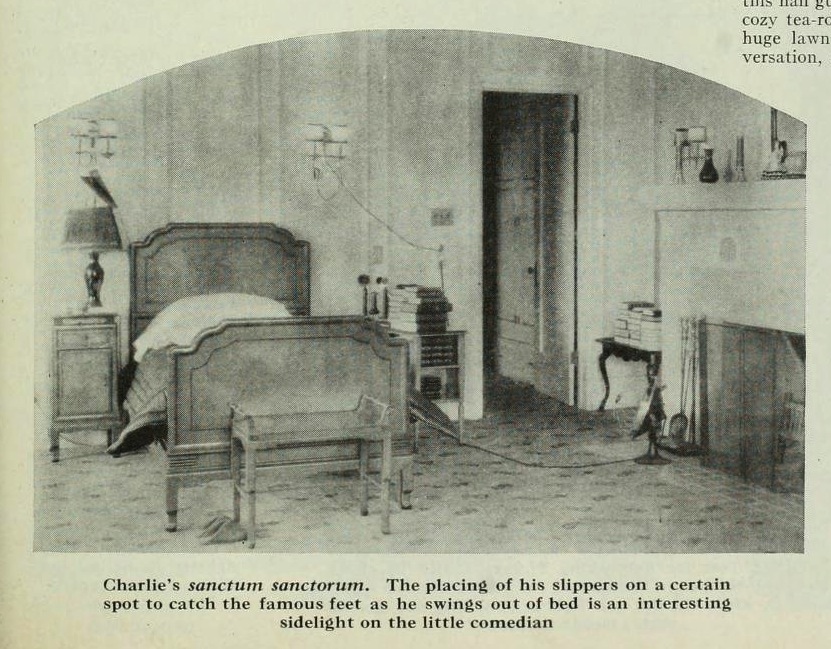
A peek into Charlie's "strictly masculine household"

The following photos & captions are from "How They Manage Their Homes" by Alma Whitaker, Photoplay, June 1929.

Charlie, Jr. remembered his father once saying: "I love this house. I'd never live anywhere else but right here."

The article says: "Here dinner is served at 8 p.m., the fashionable hour."

 Photos of Charlie, from a 1952 issue of  Illustrated magazine, sitting on the steps and standing behind the gong can be seen here and here.  

According to the article, on the mantle, facing Charlie's bed, are "four smiling photographs" of Georgia Hale, his constant companion at the time. "One of those new electric belt exercisers" stands near one of the windows.  I see a phone on the table next to his bed. He also kept a dictaphone nearby to record ideas that came to him during the night. Ms. Whitaker observes only one bed, but Charlie, Jr. noted that there were two three-quarter beds in his father's bedroom.  

Charlie's son said that his father not only liked to look at the stars with the telescope, but also his neighbors. A few more interesting notes from the article about Charlie: he wore pale green silk pajamas, as well as B.V.D.s  (a brand of men's underwear). He also hates to rise before noon. "People are so uninteresting before lunch," says Charlie. 

Lita Grey Chaplin remembered that Charlie's jade collection, "most of them nude figurines," were scattered throughout the living room. His son recalled that the living room also contained an indiscriminate assortment of furniture, including pieces his father bought for his apartments when he first moved to Los Angeles. "After he built his own place he just moved everything he possessed into it. He could never bring himself to part with anything he owned".  Charlie's press agent, Jim Tully, once observed that the colors in Charlie's living room represent his "Gipsy taste." The color scheme boasts "a mixture of reds, green, blues, and yellows, regardless of all conventional opinions on color-harmony."


This photo, taken c. 1933, is not part of the Photoplay article but shows another view of the interior. This hallway, with black & white checkered carpet and wrought iron gate, runs down the center of the house.  Adjacent to this hallway was Charlie's treasured pipe organ which can be seen in the photos below.

Charlie playing the organ, unknown date, probably late 1920s. Charlie once played the organ for David Raksin,  musical arranger for Modern Times. "Had I not been a musician, he might have been less intimidated, but he did play a little just to let me know that he had a real no-kidding organ in his house and it was sort of fun."
Lita Grey Chaplin at the organ, c. 1927
Additional sources:
Charles Chaplin, Jr., My Father, Charlie Chaplin
Lita Grey Chaplin, My Life With Chaplin
Jim Tully, "The Real Life Story Of Charlie Chaplin, Part Two," Pictorial Review, February 1927
David Raksin interview, Unknown Chaplin documentary