
September 30, 2013
Update on previous post
In my post* about the 90th anniversary of the premiere of A Woman of Paris, I said that I didn't believe Edna was at the Los Angeles premiere of the film. Just today when I was looking for information about the New York premiere, I found an article about the L.A. premiere and Edna WAS there but Chaplin himself was not. Elsewhere I have read that Chaplin deliberately hogged the publicity for this film and didn't support the actors, etc., which is clearly not the case. The fact that Chaplin chose to be absent from this premiere shows that he wanted Edna to have her well-deserved moment in the spotlight.
The following is from the Oct. 7th, 1923 issue of the Chicago Tribune:

*I have since updated this post.
The following is from the Oct. 7th, 1923 issue of the Chicago Tribune:
*I have since updated this post.
World Tour Revisited: Chaplin visits Paddington Green Children's Hospital, September 30th, 1931
'Charlie!' was the excited whisper that went round before the film comedian arrived. He spent about a quarter of hour in each ward giving his famous 'splay-footed' walk, laughing and smiling, raising his hat." (Daily Mail, October 1st, 1931)

September 29, 2013
With May Collins & Sam Goldwyn, 1921

Charlie met seventeen-year-old actress May Collins in November 1920 at the Actors' Equity Ball in New York City. They began dating shortly afterward and within a few months there were rumors of an engagement, which were neither confirmed nor denied by both parties. Although Charlie told one reporter: “I like the young lady. Like her. That is all.” As was usually the case with Charlie's relationships, he eventually grew bored with May and the relationship fizzled out by the summer of 1921. Another reason may have been that he was still sweet on Florence Deshon.
In this snippet from the August 1921 issue of Photoplay, we see that May, like many of Charlie's wives/girlfriends, was yet another victim of "Charlie Scissorhands":

Charlie & daughter Geraldine

The original caption says they are watching television. I had always read that Charlie banned TV-watching in his house. Maybe they were airing one of his films...
September 28, 2013
Chaplin with Lord & Lady Mountbatten during the filming of Nice & Friendly, 1922

Nice & Friendly was a short film Chaplin made as a wedding present for the Mountbattens, who also starred in the film along with Jackie Coogan.
The film includes one of my favorite intertitles: "But many an honest heart beats beneath a pair of baggy trousers."
Watch the film here.

Random Excerpt
From City Of Encounters by Thomas Burke (Little, Brown, 1932)
(Note: Except for one sentence, this section of Burke's essay--probably one of the best portraits ever written about Chaplin--is not part David Robinson's long excerpt in Chaplin: His Life & Art)
(Note: Except for one sentence, this section of Burke's essay--probably one of the best portraits ever written about Chaplin--is not part David Robinson's long excerpt in Chaplin: His Life & Art)
"Absorbing him as he sat in my room or moved about it (I never study people by looking at them; I can do it better by turning my eyes from them and absorbing them) I have been aware more than once of a touch of that dark, troubled quality which people have found in those artists who message was most clear and in those whose work was most "human."
There is the warm face and soft grey hair. There are the tiniest hands I have ever seen on a man. There are the clear eyes and the full-lipped, mobile mouth, and the sweet smile, a very different smile from that which he uses for public appearances and calls his "prop" smile. The hands are for ever fluttering, the sweet smile is for ever flashing, and the gentle voice for ever sending out nervous staccato sentences. These characteristics, crystallized by his electric personality (which almost makes a room vibrate) could and do command the friendship even of those few who think they dislike him. He is (still like Dickens) a man of that fierce vitality which is in itself a sign of genius. He seems to spend his last ounce on whatever he is doing, and never at any time to have any reserves. Compared with him, the little child that lightly draws its breath, and feels its life in every limb, is a study in apathy. After a few hours with him, otherwise interesting and brilliant people seem unaccountably dull. Such cascades of talk! Such inexhaustible activity! Such exuberance of spirits--so long as there is any company. Where he was here he was anxious that I should go with him to Berlin, and then to Spain. I refused. I knew that a fortnight of proximity to that million-voltage battery would have left me a cinder. But the gaiety is not spontaneous. It could not be. Charles is a brune, and the cast of our natures is described in our complexions. The easy-going people, those who quickly make friends and are thoroughly at home in the social life, the good mixers, are the blonde. An introspective blonde is as rare as a sanguine brune. The blondes turn outward. The brunes, though more vigorous and often more healthy than the blondes, turn inward. Charles, therefore, despite his vitality, cannot escape being difficult and reserved.
He is interesting enough to listen to--he is not only a copious, but a stimulating talker, agreeably acid and aerated--but he is still more interesting to watch and absorb. His movements are as piquant and precise as a ballerina's. He is slim as a faun and as graceful; so slim and light that he seems scarcely human; and it is recognizing this that one is aware of that touch of the bizarre. Warm as his fascination is, and kind as he can be, you perceive that he is withdrawn from life. He is not much interested in people, either individually or as humanity. The spectacle of life amuses or disturbs him as an artist, but its constituents are of no account to him. There is nothing, I think, that he deeply cares about. But he fears illness."
 |
| This photo of Chaplin accompanied an article in a 1922 issue of Pearson's magazine called "The Tragic Comedian." |
September 27, 2013
The Professor, 1919 (unreleased)
*Chaplin: Genius Of The Cinema/Jeffrey Vance
RIP Oona O'Neill Chaplin (May 14, 1925 - September 27, 1991)
 |
| Photo by Francis Goodman, September 1954 |
"Oona O'Neill was born with a broken heart. Knowing that, it was wonderful to make her laugh. When she laughed, she sounded like a very soft little bell ringing. Then, too, there was that marvelous bawdy side of her, when was funny and always accurate. In all the years of knowing each other we never once had an argument. I used to wonder why. I know, now, why. She could understand eight sides of every situation. However, understanding is not a point of view. She knew what to let fall away and what to embrace.
Oona was brave. But she could not put an end to the deep mourning in which she lived until her death.
Oona, that bright beautiful red rose.
But the wind was blowing softly, taking petal by petal.
Oona Chaplin died of a broken heart."
--Carol Matthau, Among The Porcupines, 1992
Cover of PARIS MATCH, September 27, 1952

The magazine's feature article was about Charlie's return to Europe in 1952. The photo below, from the same issue, shows him playing piano on the ship after its arrival at Cherbourg.

September 26, 2013

Charlie & Paulette strolling the boardwalk on Catalina Island, 1934

According to the caption attached to the back of this press photo:
"Their usual routine includes a morning paper, a little fishing, a siesta on the yacht, a swim, a stroll and then a game of tennis."
90 years ago today, A Woman Of Paris premiered at the Criterion Theater in Hollywood
"A Woman of Paris was a courageous step in the career of Charles Chaplin. After seventy films in which he himself had appeared in every scene, he now directed a picture in which he merely walked on for a few seconds as an unbilled and unrecognisable extra – a porter at a railroad station. Until this time, every film had been a comedy. A Woman of Paris was a romantic drama." --David Robinson.By 1923 Chaplin felt that his leading lady, Edna Purviance, was growing too mature for comedy. A Woman Of Paris, was his attempt to launch her on a new career as a dramatic actress. Although the film received positive critical reviews, it failed at the box office. Chaplin was so disappointed by the public's rejection of his film that he removed it from circulation at the end of the 1920s--not to be seen again for nearly 50 years.
Edna attended the Los Angeles premiere and was given a "loud burst of appreciation" when she appeared on stage after the film. She did not attend the New York premiere on Oct. 1st.
 |
| Edna. |
 |
| Edna Purviance, Nellie Bly Baker & Betty Morrissey. Baker was not an actress, but a secretary at the Chaplin Studios. Her scene-stealing performance in the film as a masseuse, led to more film roles during the 1920s. Betty Morrissey went on to appear in The Gold Rush & The Circus. She was subpoenaed for deposition during Lita Grey's divorce from Chaplin because Lita was suspicious of her relationship with Charlie. (Photo: Chaplin: Genius Of The Cinema/Vance) |
 |
| Edna Purviance and Adolphe Menjou. Although the film did not boost Edna's career as Chaplin had hoped, it did launch Menjou's. He was very impressed with Chaplin's direction: "Within a few days I realized that I was going to learn more about acting from Chaplin than I had ever learned from any director." Menjou recalled an unforgettable line that Chaplin always used when he thought the actors were hamming it up: "Don't sell sell it! Remember, they're peeking at you." This bit of advice stuck with Menjou: "Since then I have never played a scene before a camera without thinking to myself, "They're peeking at you; don't sock it." |
 |
| During a party in the Latin Quarter, the sheet around a "mannequin" is slowly unraveled. I read somewhere that Bess Flowers, who played the mannequin, was really naked underneath the cloth. |
 |
| Charlie directs Malvina Polo, who plays Paulette. I think it's interesting that Chaplin had a character in one of his films named Paulette, nearly ten years before he met Paulette Goddard. |
September 25, 2013
Chaplin at a party at Basil Rathbone's honoring Arthur Rubinstein, 1939
 |
| Charlie & Arthur Rubinstein. (Charlie's hair is dyed black for The Great Dictator) |
 |
| Basil Rathbone, Annabella, CC, & Arthur Rubinstein |
 |
| With Reginald Gardiner |
On this day 100 years ago...

Chaplin signed a one-year contract with the Keystone studio for $150 per week. The contract was signed September 25th, 1913 in Portland, OR where Chaplin was performing with the Fred Karno Company. Not wanting to quit until the Karno tour was finished, he didn't report to Keystone until the end of November. And the rest, as they say, is history.
September 24, 2013

Charlie with his mother, Hannah


September 23, 2013

Charlie & Edna with visitors, Niles, CA, 1915

Chaplin made five films for Essanay at their studio in Niles, which was a block or so away from where this photo was taken.
Photo source: Silent Traces by John Bengston
September 22, 2013
World Tour Revisited: Charlie meets Gandhi, September 22nd, 1931

Gandhi had never heard of Charlie Chaplin before this meeting and afterward called him "a very charming man."
The following is Charlie's description of their meeting from his 1933 memoir "A Comedian Sees The World":
A message from Mahatma Gandhi stated that he would like to meet me, either at the Carlton Hotel or elsewhere. We eventually decided on the home of his friend, Dr. C.L. Catial, in Beckton Road, Canning Town.
Frankly I have not followed the ramifications of Hindu politics. My knowledge has come only through the occasional scanning of the headlines in the daily press. Nevertheless, Mr. Gandhi is a figure of the twentieth century, a dissenter and reactionary of a new kind who has utilized passive resistance, a modern method in warfare, which has proven a force almost equal to violence....
Mr. Gandhi greeted me warmly...holding onto his calico as he extended one hand to shake mine.
The crowd was still cheering, so he went to the window. One of the Hindu ladies pushed me also and the Mahatma and I stood smiling and waving. Afterwards a request was made for the press to leave, but before doing so they insisted Mr. Gandhi and I pose for pictures. When the room was cleared I finally found myself seated next to him He was talking over personal matters with one of his followers.
An admirer of Gandhi's--a young English girl--sat down beside me. "Don't you think Mr. Gandhi has a wonderful personality?" she asked. "After you've talked to him I feel sure he'll win you over."
For some reason I find it difficult to make conversation, what with the milling crowds cheering outside and a gaping audience inside. I become self-conscious. It all seems like a revival meeting.
Now Mr. Gandhi is free is sits alone. Suddenly a voice breaks in: "Look here young woman, Mr. Chaplin is here to talk to Mr. Gandhi, not you. So give them a chance."
Whereupon the young lady got up and excused herself, and Mr. Gandhi and I were left on the settee.
The woman's interrupting remark terrified me. I felt it was a challenge. I shifted uneasily, then giggled at Mr. Gandhi. They must be waiting for me to say something profound.
How on earth do I get myself into these situations? I thought. Here you are, a harmless actor on a vacation, striving to have a good time, and you get into this predicament. What do you know about India, politics, cabbages and kings, and what do you want to know about them anyway?
However, I pulled myself together and started. "I was just telling the young lady that I couldn't quite agree with all your principles. I should like to know why you’re opposed to machinery. After all, it’s the natural outcome of man’s genius and is part of his evolutionary progress. It is here to free him of the bondage of slavery, to help him to leisure and higher culture. I grant that machinery with only the consideration of profit has thrown men out of work and created a great deal of misery, but to use it as a service to humanity, that consideration transcending everything else, should be a help and benefit to mankind."
"What you say is very true, but in India conditions are different," said the Mahatma. "We are a people who can live without machinery. Our climate, our mode of living, make this possible. I wish to make our people independent of industry, which weapon the western world holds over us. When they discover that there is no profit in exploiting India they will leave it to us. Therefore we must be independent of your industry. We must learn agriculture, to grown our own rice and spin our own cotton. These are essentials necessary to the lives of our people. Their wants being modest and their demands few, they do not warrant the complexities of western machinery."
"But," I argued, "you cannot retrogress. You must progress like the western world. Sooner or later you will adopt machinery."
"When that time comes we shall use it," he said. "But before doing so we must make ourselves independent of it if we are to gain freedom."After the meeting, Chaplin was invited to stay for evening prayers.
It seemed strange and unrealistic, here in this small room in the East End of London with the milling crowds outside. As the bronze diffused sun sank over the begrimed housetops, four figures sat crosslegged in silent prayer--three Hindus and one Englishwoman--while an audience of twenty or more of us looked on.
And I came away wondering whether this was the man destined to guide the lives of over three million people. (Charles Chaplin, "A Comedian Sees The World, Part IV," A Woman's Home Companion, December 1933)
September 21, 2013
Photos by Witzel & Hartsook, 1914-1915


September 20, 2013
Color home movie footage from The Great Dictator
This behind-the-scenes footage was taken by Charlie's half-brother, Sydney, during production of The Great Dictator. This is my edit of the original 26-minute footage which can be found on both the MK2 & Criterion DVD sets of the film.
Music: "The Great Dictator", from Charlie Chaplin: Essential Film Music, Carl Davis, conductor, & "Falling Star" from Oh! That Cello by Thomas Beckmann
Don't miss:
Opening shot & .21: Charlie (in costume) behind the camera
2:30: Charlie loses his temper.
2:49: Assistant director, Wheeler Dryden, Charlie's half-brother (Dryden is also the voice of the translator, Heinrich Schtick, during Hynkel's speech)
3:02: Betty Chaplin (later Betty Chaplin Tetrick, Charlie's cousin), at left wearing a white blouse, and Syd's wife, Gypsy. They are seen again at the 5:33 mark.
4:17: Henry Bergman (Bergman is not in the film but has an uncredited role as assistant).
4:28: Charlie waves to his brother.
4:45: Syd's panning shot taken from the roof of the Chaplin Studio garage, note the Hollywood sign in the distance, the set from City Lights where Charlie assessed the nude statue (5:00), & the Chaplin studio gate (5:31).

September 19, 2013
Ford Factory, Highland Park, Michigan, 1923


World Tour Revisited: Charlie visits Churchill at Chartwell, September 19th, 1931*

Chaplin & Churchill first met in 1929 at a party at Marion Davies' beach house in Santa Monica & took an immediate liking to one another. A couple of days later, Charlie invited Churchill and his entourage to his Hollywood studio where they were treated to a screening of Shoulder Arms and toured the set of City Lights. "You could not help liking him," Churchill told his wife, Clementine, in a letter, "He is a marvelous comedian--bolshy in politics--delightful in conversation." 1
Charlie remembered Churchill as a charming man with a "direct, unassuming manner. He has a slight lisp when he talks and a stoop in his carriage like Napoleon. You feel immediately a dynamic force--a man with a thirst for accomplishment. He is a wonderful talker and will rattle off brilliant epigrams. Besides being a statesman he is a great writer and an excellent painter. 2
Although they rarely saw eye to eye on politics, the two men discussed many things at Chartwell, including Charlie's interest in making a film about Napoleon. "You must do it," Churchill said. "Apart from the drama, think of its possibilities for humor. Napoleon in his bathtub arguing with his imperious brother who’s all dressed up, bedecked in gold braid, and using this opportunity to place Napoleon in a position of inferiority. But Napoleon, in his rage, deliberately splashes water over his brother’s fine uniform and he has to exit ignominiously from him. This is not alone clever psychology. It is action and fun." 3
 |
| With Churchill & his family at Chartwell in Westerham, Kent, Sept. 19th, 1931. L-R: Tom Mitford, Churchill, 2nd Lord Birkenhead, Clementine Churchill, Diana Churchill, Randolph Churchill, and Charlie. |
Next on Charlie's itinerary: A meeting with Gandhi.
_________________________________________________________________________________
* Charlie first visited Chartwell in February 1931 with his friend, Ralph Barton, who had accompanied him on his voyage to England. Barton had become obsessed about his ex-wife Carlotta Monterey's marriage to Eugene O'Neill and Charlie hoped the trip abroad would lift his friend's spirits. Not long after their arrival, Barton began acting strangely. Charlie noticed he had cut the wires to the clocks in the room, and Carlyle Robinson had even seen him holding a pistol. A few days after the City Lights premiere in London on Feb. 27th, Barton announced he was returning to the States. On May 19th he killed himself in his New York apartment. Charlie received word of his friend's suicide while he was in the south of France.
2 Chaplin, "A Comedian Sees The World, Part II," A Woman's Home Companion, Oct. 1933
3 Ibid.
September 18, 2013
World Tour Revisited: Charlie returns to London, September 18th, 1931
 |
| Voila magazine, June 16, 1934 |
Charlie arrived in London from Paris late in the evening on the 17th aboard the Golden Arrow and drove to the Carlton Hotel virtually unnoticed, a far cry from his arrival from America, nearly nine months ago to the day, in February.
May Reeves did not accompany Charlie to London, but chose to visit her parents instead. She felt her relationship with Charlie had "lost its rhythm," and that a temporary separation would do them good. Charlie agreed and gave her a "ten-day-leave." 1
 |
| Charlie (left) takes a stroll along the Embankment, September 18th, 1931 |
When Charlie awoke on the 18th, he met with reporters in his suite at the Carlton where he answered questions about his stay in London, his next film, the identity of "Mysterious Mary" and whether or not she would be in his next film. Charlie, who "seemed genuinely shy" and "twisted about a good deal on the sofa," 2 wasn't forthcoming with answers, saying only that in his next film he would still play the Tramp but would not speak in it as the Tramp but as another character, an American. Referring to "Mary" (aka May), he only said that she was not with him in London and it was too early to say whether she would be in his next picture. Charlie was also vague with reporters about his immediate plans in London saying only that he would like to visit Manchester because he once lived there and attended school, but could not remember the name of it.* At the time, Charlie intended to stay in his hometown only a few days, but ended up staying until the end of December.
As an epilogue to the scene with the journalists, Mr. Chaplin came outside the Carlton Hotel and allowed himself to be photographed buying a newspaper from the one-legged news-seller who sits in a wooden box at the corner, and for a bit Mr. Chaplin seemed the more embarrassed of the two.3
 |
| Charlie buys a newspaper from the one-legged vendor outside the Carlton. |
Coming up: Charlie spends the weekend with Winston Churchill.
_________________________________________________________________________________
1 May Reeves, The Intimate Charlie Chaplin
2 The Manchester Guardian, September 19th, 1931
3 ibid
*Charlie was enrolled at the Armitage Street School in Manchester in 1899.
September 17, 2013
With Clare Sheridan, 1921

Writer and sculptress Sheridan (a cousin of Winston Churchill) spent several days with Charlie in November 1921. She created a bust of him & camped on the beach with him & her son, Dickie. No one knows for sure if they were actually lovers. However, in her memoir, The Naked Truth, Clare wrote the following: “Dear Charlie, how funny it would have been if … and on the whole not so unsuitable but …” (the dots are hers).
British war relief party in Beverly Hills, August 1941
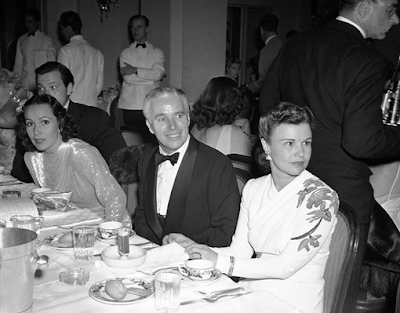


L-R: Orson Welles, Dolores Del Rio, CC, & Carmen Figueroa.
Charlie & Kono (far left) with visitors on the set of City Lights, c. 1930

Chaplin's guests are Mei Ushiyama and her husband, Harry. Evidently, Mei was a well-known beauty salon owner.
(Photo source: Charles Chaplin In Japan by Hiroyuki Ono)

Subscribe to:
Posts (Atom)